
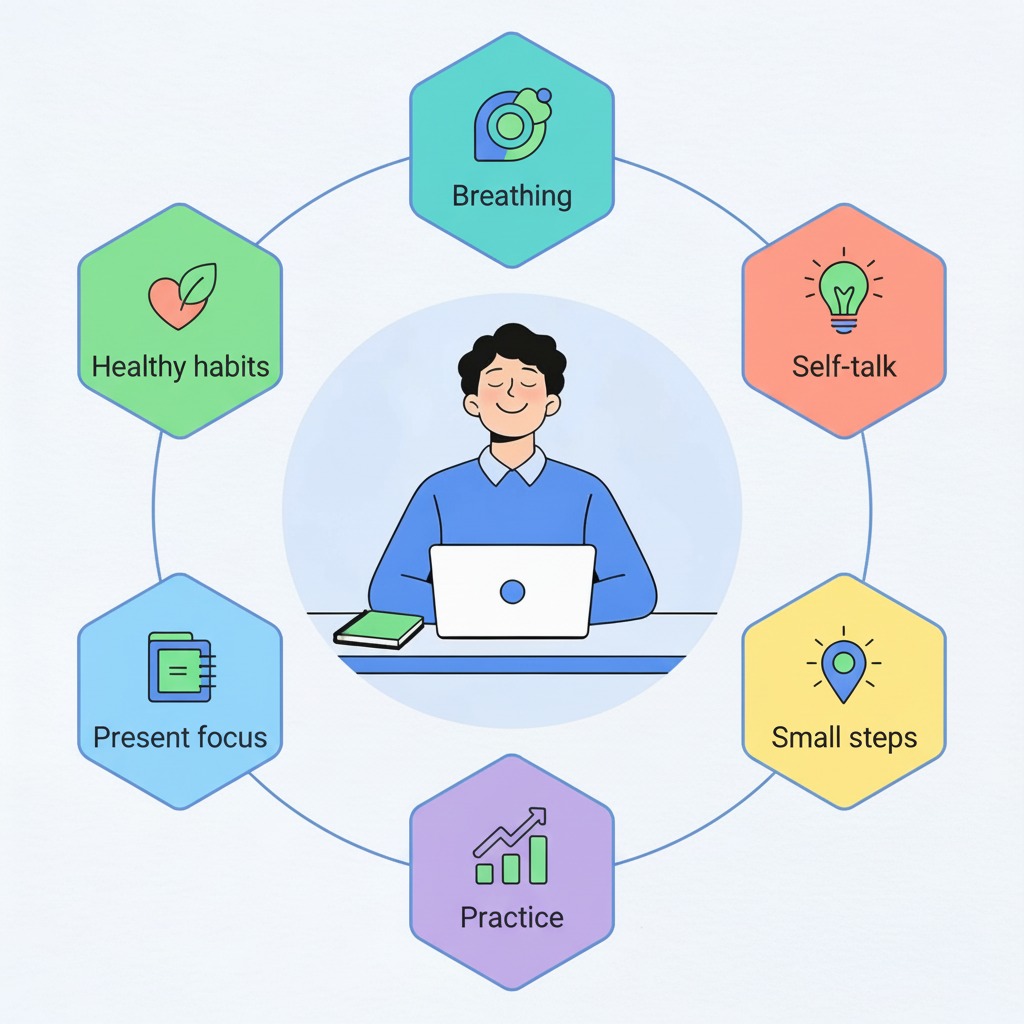
Table of Contents
1. Introduction
Performance anxiety is a widespread psychological experience that affects students, professionals, athletes, artists, and everyday individuals alike. It emerges when the mind believes that a situation carries high importance, judgment, or consequences. This could be an exam, interview, presentation, public speaking moment, performance, competition, or even a serious personal conversation. At a deeper level, it is not a sign of weakness or lack of ability. It is the brain’s protective response, designed to prevent failure, rejection, or social embarrassment by increasing alertness.
The problem begins when this alertness becomes excessive. Instead of improving focus, performance anxiety overwhelms the nervous system. The brain shifts into survival mode, prioritizing fear over clarity. Physical reactions such as rapid heartbeat, shallow breathing, sweating, shaking, dry mouth, or muscle stiffness appear. Mentally, thoughts become scattered, negative self-talk intensifies, and attention shifts from the task to imagined outcomes. This internal chaos blocks access to memory, creativity, and learned skills.
In the modern world, performance anxiety has intensified due to constant pressure to succeed and compare. Social media, academic competition, workplace demands, and cultural expectations create an environment where mistakes feel costly. Many people grow up believing that their worth depends on performance, results, or approval. This belief trains the brain to treat every important moment as a threat rather than an opportunity. As a result, the mind remains tense even before performance begins.
Another important factor is emotional overload. A tired, overstimulated, or emotionally neglected mind has fewer resources to handle pressure. Lack of rest, poor stress management, unresolved self-doubt, and chronic self-criticism all weaken emotional regulation. When the nervous system is already overwhelmed, even small performance demands can trigger anxiety.
Understanding performance anxiety changes your relationship with pressure. When anxiety is seen as a signal rather than an enemy, self-judgment reduces. You stop fighting your own mind and start listening to it. This awareness creates space for regulation, grounding, and calm focus. Performance then becomes a natural expression of preparation and ability instead of a mental struggle against fear.
Performance anxiety also develops from how the mind predicts the future. The brain is wired to anticipate outcomes, and under pressure it often imagines worst-case scenarios. Thoughts like “What if I forget,” “What if I fail,” or “What will they think of me” pull attention away from the present moment. This future-focused fear disconnects you from your body and skills, making performance feel unstable. The more the mind drifts into imagined consequences, the less access it has to clarity, memory, and creativity.
2. Performance Anxiety – What It Is and Why It Happens
Performance anxiety is the emotional, cognitive, and physical stress response that occurs when the brain fears not meeting expectations. These expectations may come from society, authority figures, family, or yourself. In such moments, the brain interprets performance as a threat to safety, identity, or self-worth. This activates the fight-or-flight system, releasing cortisol and adrenaline to prepare the body for danger. While helpful in survival situations, this response interferes with calm thinking and controlled performance.
One of the strongest causes of performance anxiety is fear of failure. When failure is linked to personal value, mistakes feel unsafe. The mind believes that failing means being judged, rejected, or seen as inadequate. This creates intense pressure to avoid mistakes at all costs. Instead of focusing on the task, attention shifts toward self-protection, leading to overthinking, tension, and mental blocks.
Perfectionism also plays a major role in performance anxiety. When the mind believes that only flawless results are acceptable, pressure becomes unbearable. Small errors feel catastrophic. The brain stays hyper-alert, constantly monitoring performance instead of allowing natural flow. This constant self-monitoring drains mental energy and increases anxiety, often reducing performance quality.
Another key factor is over-identification with outcomes. When success defines identity, every performance becomes personal. Winning, approval, or praise become emotional needs rather than goals. Past experiences such as criticism, embarrassment, public failure, or comparison can strengthen this association. The brain learns to expect danger in similar situations and triggers anxiety automatically.
By understanding why performance anxiety happens, you move from self-blame to self-awareness. This shift reduces fear and increases control. When the nervous system feels safer, the mind becomes clearer. With awareness, regulation, and supportive habits, it can be managed, allowing you to perform with calm, confidence, and presence learning to bring attention back to the present is essential because performance can only happen now, not in imagined outcomes.
Another hidden cause of performance anxiety is lack of emotional safety during growth. When people grow up in environments where mistakes were punished, criticized, or mocked, the brain learns to associate performance with danger. Even years later, similar situations trigger the same stress response. The body reacts before logic can intervene. This explains why reassurance alone often fails to reduce anxiety. Healing requires retraining the nervous system to experience performance as safe, supportive, and non-threatening, allowing confidence to emerge naturally rather than being forced.
3. Performance Anxiety – How Stress Impacts Performance and Mental Health
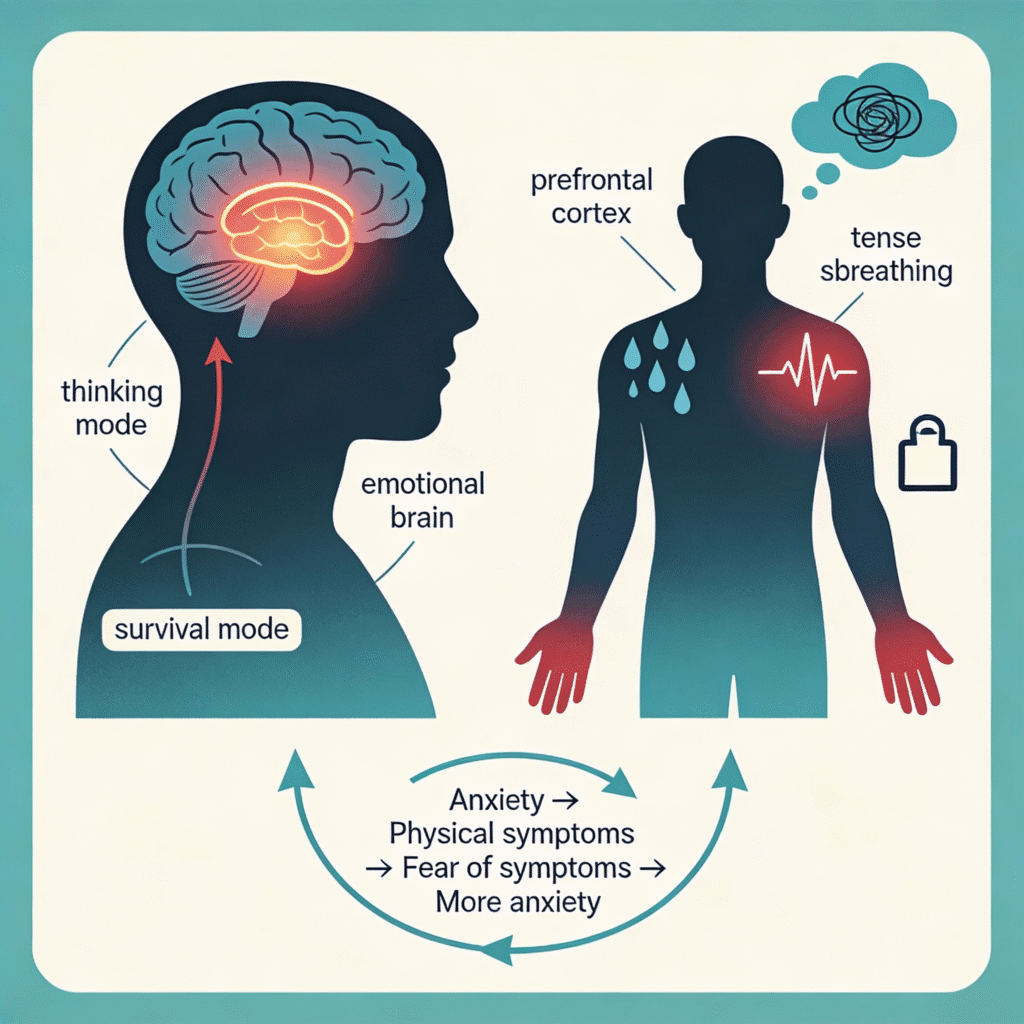
Performance anxiety affects the mind and body as a connected system. When stress levels rise beyond a manageable point, the brain shifts from thinking mode to survival mode. The prefrontal cortex, which controls focus, memory, reasoning, and decision making, becomes less active. At the same time, the emotional brain takes control. This shift explains why people suddenly blank out, forget prepared answers, or feel mentally frozen during important moments. It is not a lack of ability but a stress overload that blocks access to skills.
As performance anxiety increases, the body reacts strongly to perceived threat. Common symptoms include racing thoughts, muscle tension, sweating, shaking, fast heartbeat, shallow breathing, nausea, dizziness, or a dry mouth. These physical reactions are natural stress responses, but they often feel alarming. When the mind notices these sensations, it may interpret them as danger signals, which increases fear and worry instead of calming the system.
This reaction creates a powerful feedback loop. Anxiety triggers physical symptoms. Physical symptoms increase fear. Fear increases anxiety further. The person becomes more focused on controlling symptoms than performing the task. Attention turns inward, away from the present activity, making concentration and confidence even harder to maintain.
With repeated exposure, performance anxiety can deeply affect mental health. Many people begin avoiding situations that trigger discomfort. They may delay opportunities, skip challenges, or withdraw from activities they once enjoyed. While avoidance reduces anxiety temporarily, it reinforces fear over time. The brain learns that escape equals safety, which strengthens anxiety patterns.
Long term performance anxiety also drains emotional energy. When the nervous system stays on high alert, relaxation becomes difficult. Sleep may become disturbed, emotional regulation weakens, and irritability increases. Over time, this constant tension can lead to emotional exhaustion, reduced motivation, and burnout. The person may feel mentally tired even without physical effort.
Learning to manage stress is not only about better performance. It is about protecting mental wellness. When stress is regulated, the brain regains clarity, emotions stabilize, and self trust returns. Calm performance supports long term psychological health, allowing growth without fear and effort without emotional damage.
4. Performance Anxiety – The Power of Calm Performance Under Pressure
Performance anxiety does not fade by forcing confidence or suppressing fear. When anxiety is pushed away, the nervous system interprets this resistance as danger, which increases internal pressure. Calm performance develops when the body feels safe enough to function normally under stress. This state allows anxiety to exist without taking control. Instead of fighting nervousness, the mind learns to work with it, reducing emotional resistance and mental overload during high pressure situations.
Calm performance begins with nervous system regulation. When the body is regulated, the brain shifts out of survival mode and returns to higher level functioning. Breathing slows down, heart rate stabilizes, and muscle tension decreases. These physical changes send calming signals to the brain, improving focus and mental clarity. As the body relaxes, the mind follows, making it easier to think, remember, and respond effectively.
When calm performance is present, attention stays anchored in the present moment. The mind stops jumping to future outcomes or replaying fears of judgment and failure. Instead of worrying about results, attention moves toward execution and process. This present moment focus allows skills and preparation to surface naturally, rather than being blocked by stress. Performance becomes smoother and more controlled.
Emotional regulation is another key benefit of calm performance. Mistakes and unexpected challenges are handled with composure rather than panic. Instead of emotional reactions, the mind stays flexible and adaptive. This prevents one error from triggering self doubt or emotional collapse. Calm performance allows faster recovery, which is essential in situations where pressure and unpredictability are unavoidable.
Over time, calm performance builds deep self trust. Confidence becomes grounded in emotional control rather than perfection. You begin to trust your ability to stay composed even when anxiety appears. Pressure stops feeling like a threat and starts feeling manageable. This shift reduces fear and strengthens resilience, allowing you to approach performance situations with stability instead of avoidance.
Most importantly, calm performance improves mental wellness beyond performance itself. The nervous system learns that pressure does not equal danger. This reduces chronic stress, improves sleep quality, and strengthens emotional balance. Calm performance supports long term psychological health by teaching the mind and body how to respond with stability instead of fear. With practice and compassion, calm performance becomes a reliable inner skill rather than a temporary state.
5. Performance Anxiety Management – 6 Ways to Improve Stress Control and Calm Performance
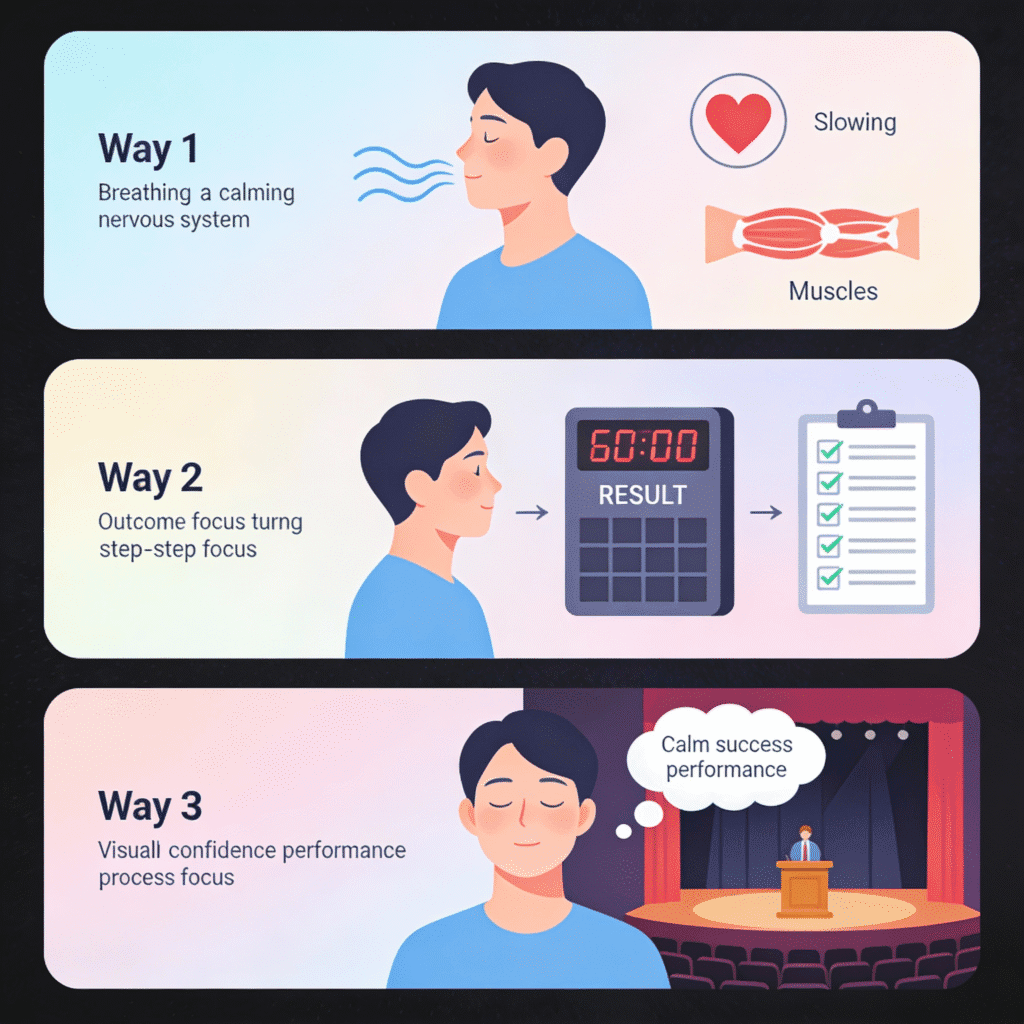
Way 1: Performance Anxiety Management Through Breathing Regulation
Performance anxiety intensifies when breathing becomes shallow, fast, and irregular. This type of breathing sends a danger signal to the brain, activating the stress response and increasing adrenaline levels. As a result, the heart rate rises, muscles tighten, and thinking becomes scattered. Many people are unaware that their breathing pattern is one of the main reasons anxiety escalates during performance situations.
Slow and controlled breathing activates the parasympathetic nervous system, which is responsible for calming the body. Deep nasal breathing followed by slow exhalation helps regulate heart rate and reduces physical tension. When breathing slows down, the brain receives a signal that the situation is safe, allowing focus and clarity to return naturally. This makes breathing one of the fastest tools for stress control.
With regular practice, breathing regulation retrains the nervous system. The body learns that pressure does not automatically mean danger. Over time, intentional breathing before and during performance becomes an automatic calming response. This builds emotional stability and allows calm performance even in situations that previously triggered intense anxiety.
Way 2: Performance Anxiety Management by Shifting Focus From Outcome to Process
Performance anxiety increases sharply when the mind becomes obsessed with outcomes. Thoughts about success, failure, judgment, comparison, or consequences overwhelm attention. The mind jumps into future scenarios that may never happen, creating unnecessary pressure and emotional overload. This outcome fixation pulls attention away from the present moment.
Shifting focus to the process brings attention back to what you can control. Instead of worrying about results, you focus on the next action such as speaking the next sentence, executing the next movement, or following the next step. This keeps the mind anchored in the present and prevents anxiety from spiraling into fear-based thinking.
Process-focused attention builds confidence because it removes the emotional weight of expectations. You stop performing to prove something and start performing to execute skills. This shift reduces pressure, improves concentration, and allows calm performance to emerge naturally through engagement rather than force.
Way 3: Performance Anxiety Management Through Mental Rehearsal
Performance anxiety often comes from uncertainty and fear of the unknown. Mental rehearsal helps reduce this uncertainty by preparing the brain in advance. When you visualize a situation clearly, the brain treats it as a familiar experience rather than a threat. This reduces shock and emotional overload during actual performance.
Effective mental rehearsal involves imagining yourself performing calmly, clearly, and confidently. It is important to include realistic challenges such as mistakes or unexpected moments and visualize yourself responding with composure. This trains the brain to stay regulated even when things do not go perfectly.
With repeated mental rehearsal, emotional readiness improves. The mind becomes familiar with the experience, reducing fear and hesitation. When the real situation occurs, anxiety is lower because the brain recognizes the pattern. This familiarity supports calm performance and smoother execution.
Way 4: Performance Anxiety Management Through Emotional Acceptance
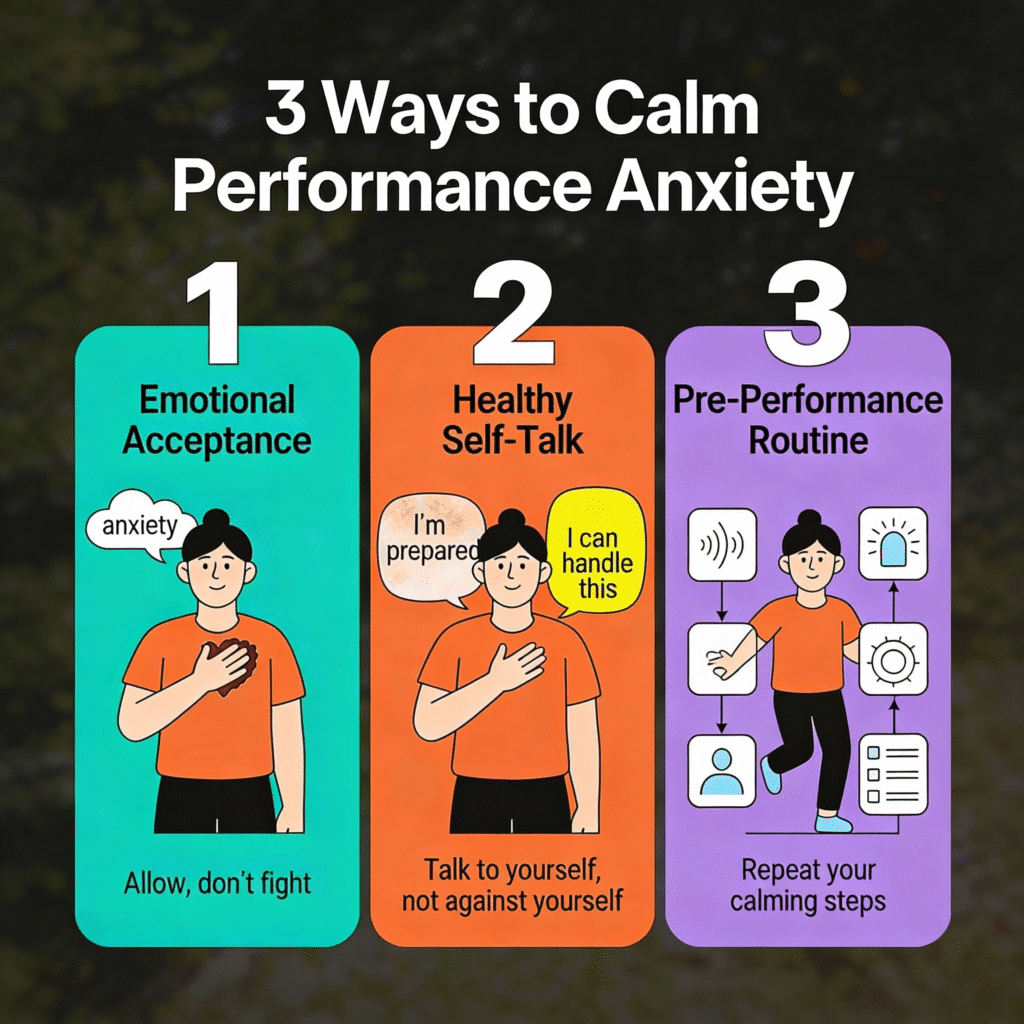
Performance anxiety often worsens when people try to suppress or eliminate nervousness. Fighting anxiety creates internal resistance, which increases tension and emotional intensity. The brain interprets resistance as danger, making anxiety feel stronger and more overwhelming.
Emotional acceptance means allowing anxiety to exist without judgment. Instead of labeling nervousness as bad or dangerous, you observe it calmly. When anxiety is acknowledged without fear, the nervous system begins to relax. The emotional charge decreases because the mind is no longer fighting itself.
Acceptance creates psychological space. Anxiety may still be present, but it no longer controls behavior. This approach builds emotional resilience and stress tolerance. Calm performance becomes possible because energy is not wasted on resistance but directed toward action and presence.
Way 5: Performance Anxiety Management Through Healthy Self-Talk
Performance anxiety is strongly influenced by inner dialogue. Negative self-talk activates fear, self-doubt, and stress responses. Thoughts that predict failure or judgment increase emotional pressure and weaken confidence. The mind believes what it repeatedly hears.
Healthy self-talk replaces threat-based language with supportive and realistic statements. Reminding yourself of preparation, effort, and capability reduces fear and stabilizes emotions. This does not mean ignoring challenges, but responding to them with balance and encouragement rather than criticism.
Over time, consistent healthy self-talk reshapes emotional responses. The inner voice becomes a source of grounding instead of pressure. This internal support system strengthens stress control and allows calm performance to develop even in demanding situations.
Way 6: Performance Anxiety Management Through Pre-Performance Routines
Performance anxiety decreases when the brain experiences familiarity and predictability. Pre-performance routines create a sense of structure and control before high-pressure situations. When the brain recognizes a repeated routine, it associates it with safety and readiness.
A pre-performance routine may include breathing exercises, light movement, visualization, affirmations, or grounding techniques. The specific actions matter less than consistency. Repeating the same routine conditions the nervous system to enter a focused and calm state automatically.
Over time, these routines become psychological anchors. Even in intense environments, the body remembers the calming pattern. This reduces anxiety spikes and supports calm performance. Pre-performance routines help transform pressure into a familiar and manageable experience rather than a threat.
6. Conclusion
Performance anxiety does not define your intelligence, ability, or future success. It reflects a mind that is alert, invested, and emotionally engaged with what matters to you. People who care deeply about growth, learning, and results often experience anxiety because their mind attaches meaning to performance. This does not make you weak. It means your nervous system is trying to protect your sense of identity and self-worth. Understanding this removes shame and replaces it with clarity.
A balanced path forward begins when awareness replaces resistance. Many people worsen anxiety by fighting it, suppressing it, or judging themselves for feeling nervous. This creates internal conflict and emotional tension. When you observe anxiety calmly, without labeling it as failure, the nervous system begins to settle. Awareness allows you to notice early signs of stress and respond intentionally instead of reacting automatically. This shift is the foundation of emotional regulation.
Stress control and calm performance are built through small, repeatable practices rather than dramatic changes. Techniques like breathing regulation, grounding exercises, mental reframing, and consistent routines slowly teach the brain that pressure is manageable. Each time you respond calmly to stress, the nervous system learns safety. Over time, these responses become automatic, reducing the intensity and duration of anxiety during performance situations.
At MindQuora, mental wellness is about balance, not perfection or constant confidence. You do not need to eliminate anxiety to perform well or feel capable. What matters is creating an internal environment where the mind feels supported rather than threatened. When the brain feels emotionally safe, focus improves naturally and thinking becomes clearer. Performance then becomes an expression of preparation and presence, not a test of personal value.
Calm performance develops through patience, self-trust, and repeated self-support. Progress is rarely linear. Some days anxiety feels lighter, and other days it feels stronger. This does not mean you are moving backward. Each experience strengthens emotional awareness and resilience. Confidence grows when you show yourself that you can stay present even when discomfort exists.
When you learn to work with your mind instead of against it, performance anxiety changes its role in your life. It becomes a signal that guides you toward better regulation, preparation, and self-care. Pressure stops feeling like danger and starts feeling like a space for growth and learning. With balance, compassion, and consistency, performance anxiety no longer blocks your potential. It becomes part of the process that strengthens it.