

Table of Contents
1. Introduction
Goal setting strategies are the backbone of achievement. They provide the structure, clarity, and discipline that transform dreams into actionable outcomes. Many people begin with excitement but struggle to maintain consistency, especially when working on long-term goals that require sustained effort over months or years. Without clear strategies, motivation fades, distractions multiply, and goals are abandoned.
Goal setting strategies bridge the gap between intention and accomplishment. They not only define what success looks like but also provide the daily framework to stay motivated throughout the journey. Whether you’re a student aiming for academic excellence, a professional targeting a promotion, or an entrepreneur building a business, structured planning is the key to progress.
To illustrate, think of two people who want to run a marathon. One says, “I’ll just run whenever I feel like it.” The other follows a plan—running 5 km thrice a week, gradually increasing distance, maintaining diet, and tracking progress. Guess who’s more likely to reach the finish line? The difference lies in applying goal setting strategies.
In this blog, we’ll dive into 10 actionable goal setting strategies that anyone can apply to achieve long-term goals. From clarity and prioritization to resilience and celebration, these strategies cover every stage of the goal-setting journey.
2. Understanding Goal Setting
At its core, goal setting is the deliberate process of identifying something you want to accomplish and creating a plan to achieve it. It’s not just about ambition—it’s about structure. Without structure, goals remain wishes.
Psychologists Edwin Locke and Gary Latham, pioneers of the Goal-Setting Theory, found that specific and challenging goals lead to higher performance compared to vague or easy goals. This is why goal setting strategies emphasize measurable objectives, deadlines, and alignment with personal development values.
There are two broad types of goals:
- Short-term goals: Smaller objectives like reading a book this month, saving ₹5,000 this week, or completing a project by Friday.
- Long-term goals: Larger ambitions like completing a degree, writing a novel, buying a house, or achieving financial independence.
Both work hand-in-hand. Short-term goals provide momentum, while long-term goals provide direction. Without long-term vision, short-term achievements lack purpose; without short-term steps, long-term goals remain distant.
Practical Example: A college student aiming for a high-paying job after graduation sets long-term goals like building industry knowledge and networking. But along the way, short-term goals like completing internships, acing projects, and upskilling through online courses keep the momentum alive.
3. Why Goal Setting Strategies Matter for Long-Term Goals
Long-term goals are inherently challenging. They demand patience, resilience, and adaptability. The excitement of starting is easy, but sustaining motivation over months or years requires a systematic approach. This is where goal setting strategies become invaluable.
Imagine someone preparing for a civil services exam in India. The preparation may take two to three years. Without clear strategies like daily study routines, milestone-based tracking, and resilience-building practices, most candidates would give up halfway.
Similarly, entrepreneurs often start with enthusiasm but face setbacks—financial hurdles, market competition, or personal stress. Goal setting strategies ensure they keep moving forward, even when results are delayed.
Research published in the American Journal of Lifestyle Medicine shows that people who use structured goal-setting techniques are 42% more likely to achieve their goals than those who simply “try harder.” This demonstrates that discipline and strategy are more powerful than raw willpower alone.
Case Study: Elon Musk, when working on SpaceX, didn’t just dream of rockets. He broke his long-term vision of colonizing Mars into short-term, measurable milestones—building reusable rockets, testing payload launches, and reducing costs. Without structured goal setting strategies, such a vision would remain science fiction.

4. Goal Setting Strategies: 10 Actionable Steps
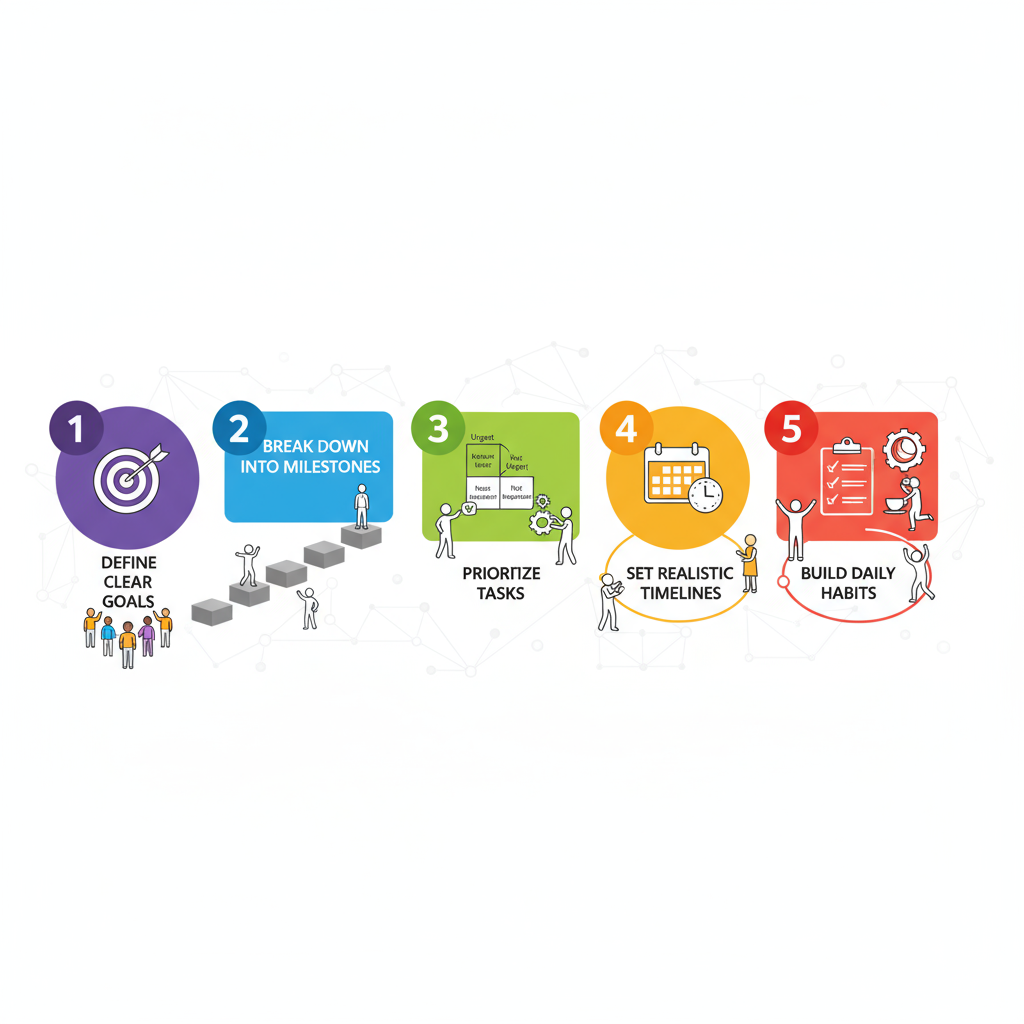
Step 1: Define Clear and Specific Goals
Ambiguity kills progress. Saying “I want to get fit” is too vague. Instead, a clear goal might be: “I want to lose 10 kg in 5 months by working out 4 times a week and maintaining a 1,500-calorie diet.”
Clear goals activate the brain’s Reticular Activating System (RAS), which filters opportunities and information that align with your objectives. For example, once you set a fitness goal, you start noticing healthier food options or workout tips you might have previously ignored.
Practical Tip: Write your goals in the present tense—“I am improving my health by running 5 km daily”—to create psychological ownership.
Step 2: Break Down Long-Term Goals into Milestones
A mountain looks impossible to climb until you divide it into steps. Breaking long-term goals into milestones prevents overwhelm and sustains motivation.
Example: If your goal is to save ₹6,00,000 in three years, the milestone could be ₹2,00,000 per year, or roughly ₹16,700 per month. Each milestone achieved provides confidence for the next.
Case Study: J.K. Rowling didn’t write the Harry Potter series in one go. She divided it into smaller drafts, chapters, and revisions, eventually producing one of the most successful franchises in history.
Practical Insight: Treat milestones as mini-goals. Every time you complete one, celebrate—it builds psychological momentum.
Step 3: Prioritize and Focus on What Truly Matters
Not all goals carry the same weight. Goal setting strategies encourage prioritization to avoid spreading energy too thin.
The Pareto Principle (80/20 rule) states that 80% of results come from 20% of efforts. For instance, if your goal is career growth, instead of focusing on minor tasks like perfecting email formatting, prioritize skill development, networking, and performance in major projects.
Practical Tool: Use the Eisenhower Matrix—categorize tasks into urgent/important, important/not urgent, urgent/not important, and not urgent/not important. Focus on the first two quadrants for maximum productivity.
Step 4: Create a Realistic Timeline and Deadlines
Deadlines transform intentions into commitments. Without timelines, procrastination becomes inevitable.
For example, if you plan to complete an online course, set a specific deadline: “I will finish in 8 weeks by studying 5 hours per week.” Timelines create a sense of urgency, making daily progress non-negotiable.
Research from Psychological Science shows that individuals who set specific deadlines are 64% more likely to complete their tasks compared to those who don’t.
Pro Tip: Use backward planning—start from your desired end date and work backward to schedule milestones.
Step 5: Build Consistent Daily Habits
Habits are the invisible architecture of success. Big goals are rarely achieved in one leap; they’re built through small, consistent actions.
Example: Writing just 500 words daily results in 1,82,500 words in a year—enough for two full-length books.
James Clear, in Atomic Habits, argues that improving 1% every day compounds into massive growth over time. Goal setting strategies emphasize routine because consistency beats bursts of inspiration.
Practical Tip: Try habit stacking—attach a new habit to an existing one. For example, meditate for 5 minutes after brushing your teeth.
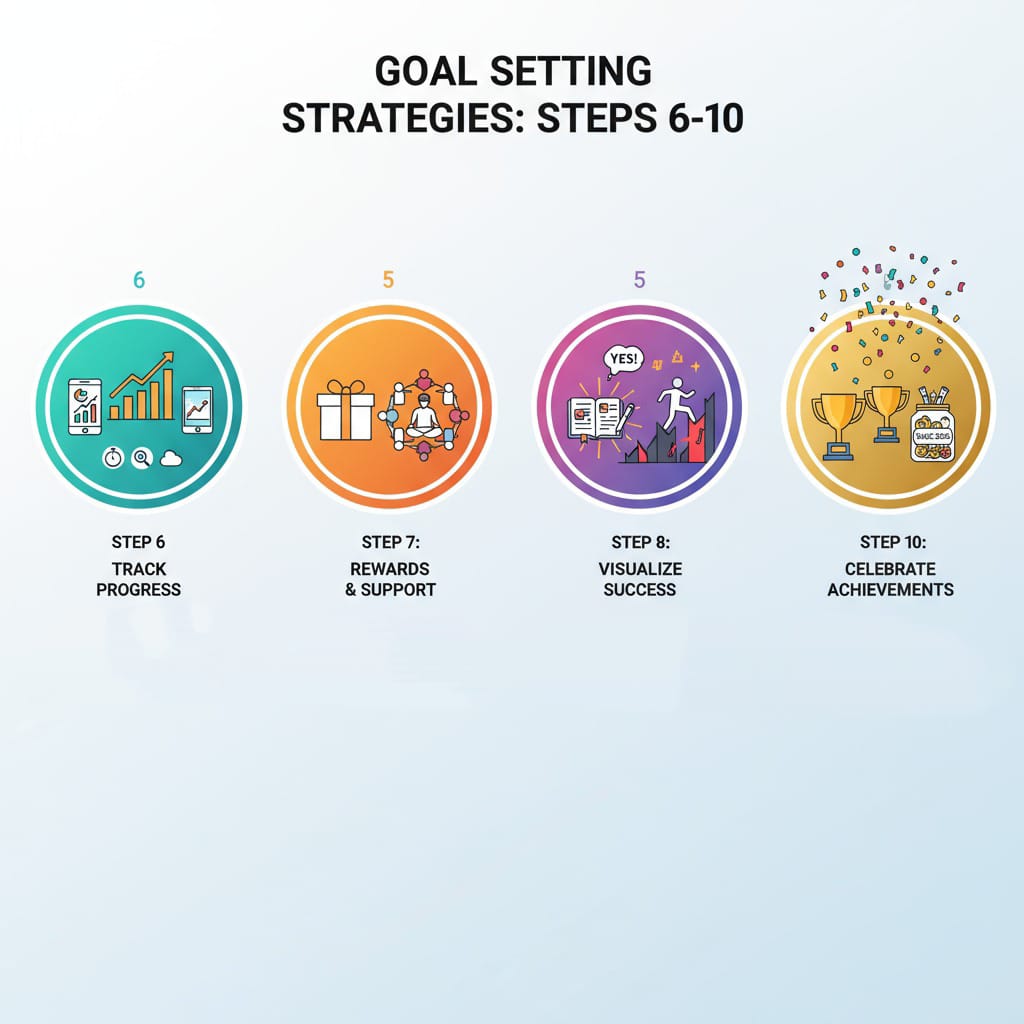
Step 6: Track Progress and Adjust When Needed
What gets measured gets managed. Tracking allows you to celebrate wins and identify areas of improvement.
For fitness, apps like MyFitnessPal track calorie intake; for productivity, tools like Notion or Trello monitor tasks.
Example: A student preparing for exams should track weekly scores in mock tests. If scores stagnate, they can adjust strategies by focusing on weaker subjects or changing study techniques.
Practical Insight: Regularly review progress weekly or monthly. Adjusting early prevents wasted time and keeps you aligned with your goals.
Step 7: Stay Motivated with Rewards and Support Systems
Motivation fades if it isn’t reinforced. That’s why rewards and support systems matter.
Example: Reward yourself with a weekend outing after sticking to a fitness plan for a month. Rewards release dopamine, creating positive reinforcement.
Support systems like mentors, accountability partners, or study groups also play a big role. According to the American Society of Training and Development, having an accountability partner increases goal achievement by 65%, and regular check-ins boost it to 95%.
Pro Tip: Share your goals with supportive people, not critics. Positive encouragement keeps motivation strong.
Step 8: Visualize Success and Use Affirmations
Visualization is not fantasy—it’s mental rehearsal. Research from the Journal of Sports Sciences shows that athletes who visualize success perform significantly better than those who don’t.
Practical Example: Before a job interview, visualize yourself walking in confidently, answering questions calmly, and shaking hands with the interviewer at the end. This mental image reduces anxiety and boosts confidence.
Affirmations like “I am resilient and capable” help rewire negative self-talk into empowering beliefs. Over time, these beliefs shape actions.
Step 9: Learn from Setbacks and Build Resilience
Setbacks are inevitable, but resilience determines whether you give up or grow.
Example: Thomas Edison failed over 1,000 times before inventing the light bulb. Instead of calling them failures, he reframed them as “steps closer to success.”
Goal setting strategies encourage reframing mistakes as lessons. Mindfulness practices, journaling, or simply analyzing what went wrong can help you adapt and move forward.
Pro Tip: Use the “Failure Log” technique—write down lessons from every setback. Over time, you’ll build a personal handbook of resilience.
Step 10: Celebrate Achievements and Set New Goals
Every achievement, big or small, deserves recognition. Celebration reinforces confidence and motivation.
Example: Completing your first 5K run is worth celebrating—even if your ultimate goal is a marathon. The celebration fuels momentum for the next challenge.
Once goals are achieved, set new ones to maintain growth. Continuous goal-setting prevents stagnation and ensures lifelong learning.
Practical Tip: Use the “Success Jar”—write down every achievement on a slip of paper and review them at the end of the year to appreciate progress.
5. The Link Between Goal Setting and Staying Motivated
Goal setting strategies and motivation are deeply interconnected, almost like two sides of the same coin. Motivation provides the emotional spark that pushes us to begin, while structured goals provide the roadmap that keeps us moving forward. Without defined goals, motivation often becomes fleeting and directionless.
For example, someone might feel inspired to “get healthier” after watching a fitness video, but without a concrete plan, that enthusiasm fades quickly. On the other hand, if the same person applies clear goal setting strategies—such as exercising four times a week, reducing sugar intake, and tracking their weight—they have a framework to sustain motivation long after the initial excitement wears off. Research also supports this relationship.
A study published in the Journal of Applied Psychology revealed that people who set specific and challenging goals performed almost 90% better than those with vague or easy goals. The reason is simple: motivation thrives when it has clarity, measurable progress, and accountability. Thus, goal setting strategies do not just organize your actions—they fuel the motivation needed to stay committed, even in the face of difficulties.
6. Benefits of Applying Goal Setting Strategies
The benefits of applying goal setting strategies extend far beyond achieving a single objective. They create a sense of clarity, as you know exactly what you’re working toward and why it matters. This clarity reduces confusion and helps filter out distractions, allowing energy to be invested in meaningful pursuits.
Another benefit is improved focus, since priorities become clearly defined and decision-making becomes easier. Time management also improves because deadlines and milestones transform vague intentions into structured commitments, making procrastination less likely.
Additionally, goal setting strategies strengthen resilience. By breaking larger ambitions into smaller steps, setbacks no longer feel like failures but opportunities to adjust the path. This builds mental toughness, as individuals learn to bounce back stronger each time. A real-world example can be seen in companies like Google, which use the OKR (Objectives and Key Results) system to align individual efforts with organizational goals.
This framework not only drives innovation but also ensures consistent progress across teams. Similarly, on a personal level, someone saving for a house can stay motivated by watching their savings grow each month, no matter how small the contribution. The process itself becomes rewarding, leading to a deeper sense of fulfillment. In short, the benefits of goal setting strategies are holistic—they increase productivity, boost confidence, reduce stress, and create long-term satisfaction by turning dreams into measurable achievements.
7. Common Mistakes to Avoid
While goal setting strategies are powerful, many people fall short because of common mistakes that derail progress. One of the most frequent errors is setting vague goals, such as saying “I want to do better in my career” without clarifying what “better” means. Without measurable outcomes, there is no way to track progress, and motivation quickly fades.
Another mistake is attempting to pursue too many goals at once, which dilutes focus and leads to burnout. For instance, trying to learn a new language, start a business, and train for a marathon simultaneously may leave a person feeling overwhelmed and eventually abandoning all three.
Unrealistic deadlines also contribute to failure. When goals are set with timelines that are impossible to achieve, frustration and discouragement take over. People also make the mistake of treating setbacks as final failures rather than as learning opportunities. Successful goal setters, however, view obstacles as feedback that helps them refine their strategies.
A lack of flexibility is another issue; life circumstances can change, and rigidly sticking to outdated goals may cause more harm than good. The solution lies in conducting regular “goal audits”—periodic reviews that allow adjustments, refinements, or even complete redefinitions of goals based on changing priorities. By avoiding these mistakes, individuals ensure that their goal setting strategies remain practical, realistic, and sustainable in the long run.
8. Practical Tips to Stay Consistent
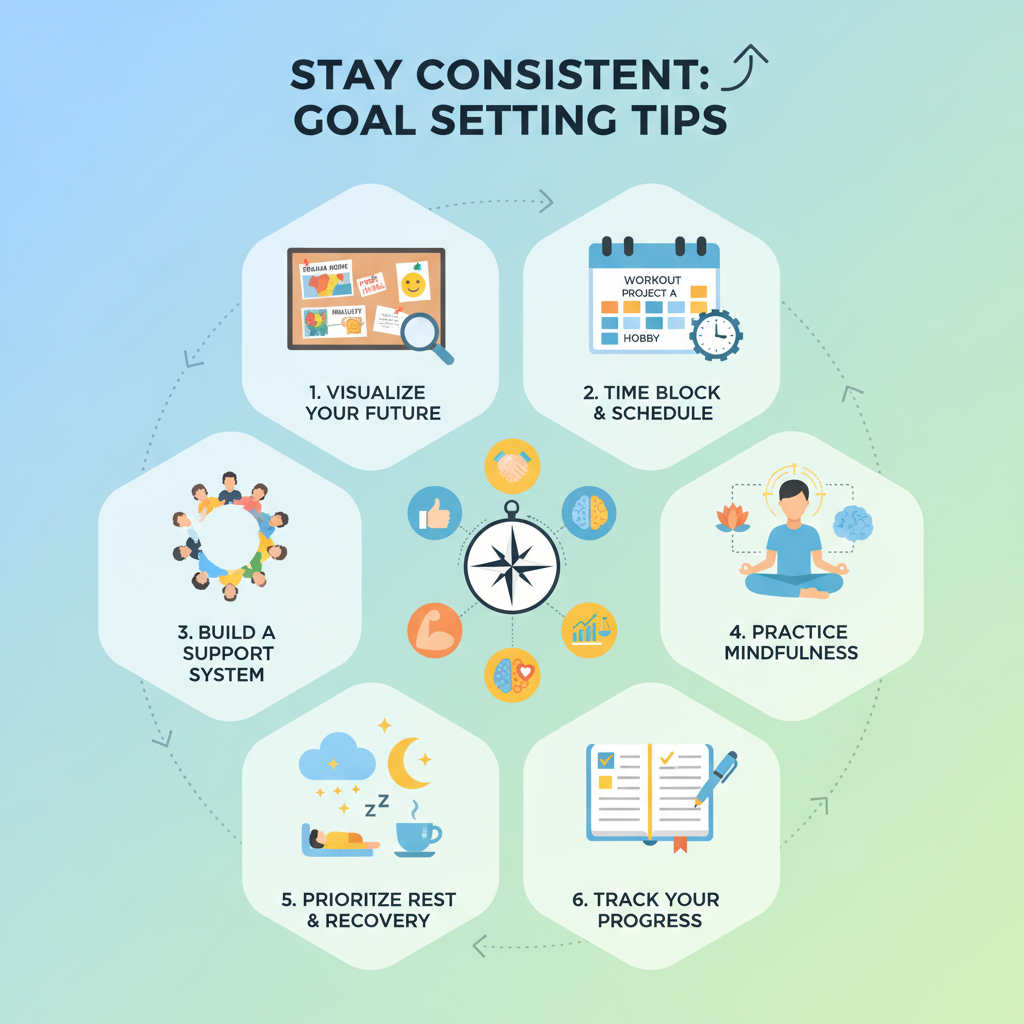
Consistency is the cornerstone of success, and goal setting strategies are effective only when applied steadily over time. One way to stay consistent is by keeping your goals visible. Vision boards, sticky notes, or digital reminders can serve as daily motivators, reinforcing why the effort matters.
Time-blocking is another powerful technique, where specific hours of the day are dedicated to high-priority tasks, ensuring progress even amidst a busy schedule. Surrounding yourself with supportive people—whether friends, mentors, or accountability partners—also strengthens consistency by providing encouragement during difficult times.
Mental wellness plays a role here as well. Practicing mindfulness or meditation helps reduce stress and keeps the mind clear, which directly impacts one’s ability to stay disciplined. Another important tip is balancing ambition with rest. Overworking may yield short-term progress, but it often leads to burnout, which can derail long-term goals entirely.
Finally, maintaining a progress journal encourages reflection. Writing down daily or weekly progress allows you to see how far you’ve come, making it easier to push forward when motivation wanes. These practical tips show that consistency is less about extraordinary effort and more about cultivating steady habits that align with long-term aspirations. By embedding consistency into daily life, goal setting strategies become not just a framework for success, but a lifestyle that drives continuous growth.
9. FAQs
Q1. How do I stay motivated when progress feels slow?
Focus on small wins and track incremental progress. Remind yourself that success compounds over time.
Q2. What’s the best strategy for beginners?
Start with SMART goals and build consistent daily habits. Don’t overload yourself at the start.
Q3. Should I change goals midway?
Yes. Flexibility is important. Adapting doesn’t mean failure—it means growth.
Q4. What role do accountability partners play?
They increase commitment, making you up to 95% more likely to succeed.
Q5. Are short-term or long-term goals more important?
Both. Short-term goals create momentum; long-term goals provide direction.
10. Conclusion
Goal setting strategies are not just techniques you apply once; they are lifelong habits that create the foundation for achievement, growth, and personal fulfillment. When people dream without structure, their goals often remain wishes. But when those dreams are guided by proven strategies—clear goal definition, milestone planning, consistent habits, progress tracking, and resilience—they transform into measurable results.
Goal setting strategies also bridge the gap between motivation and discipline. Motivation gives you the initial push, but discipline ensures that you keep going even when excitement fades. For example, a student preparing for competitive exams may begin with enthusiasm, but only those with a structured strategy—daily study plans, mock tests, progress reviews, and motivational support systems—are able to sustain their efforts over years and ultimately succeed.
Another important aspect is that goal setting strategies connect short-term actions with long-term goals. Every small step—waking up early to exercise, saving a small amount of money daily, writing a single page of a book—compounds over time into life-changing achievements. This compounding effect demonstrates why consistency is more powerful than occasional bursts of effort.
Goal setting strategies are also highly adaptable. Life is unpredictable, and setbacks are inevitable. But when you use flexible strategies, setbacks do not mean failure—they become opportunities to refine your methods. For example, an entrepreneur may face a failed product launch, but by reassessing milestones, reworking timelines, and learning from mistakes, they can use the experience to create a stronger, more successful business model.
Equally significant, goal setting strategies support mental wellness. Working without structure often leads to stress, anxiety, and burnout. In contrast, having clear, realistic goals provides focus and reduces mental clutter. Celebrating achievements, no matter how small, builds self-esteem and creates a positive feedback loop that keeps you motivated for the next challenge.
To summarize, the 10 actionable goal setting strategies—defining specific goals, breaking them into milestones, prioritizing, creating timelines, building habits, tracking progress, staying motivated, visualizing success, learning from setbacks, and celebrating achievements—form a comprehensive roadmap for success. They combine the psychology of motivation with the practicality of structured planning.
Goal setting strategies remind us that success is not a single event but a journey of disciplined action, resilience, and adaptability. By applying these steps consistently, anyone—whether a student, professional, or entrepreneur—can not only set ambitious long-term goals but also stay motivated and achieve them.
In the end, it is not about how quickly you reach your destination, but how steadily and effectively you walk the path. With clear strategies in place, setbacks will only strengthen your resolve, and every achievement, no matter how small, will bring you closer to your ultimate vision of success.