

Table of Contents
Introduction
Visualization for success is one of the most transformative practices anyone can adopt in their journey toward achieving personal or professional goals. At its core, it is the ability to mentally picture a desired outcome and experience it in the mind before it manifests in reality. Unlike casual daydreaming, which often floats without direction, visualization techniques is a structured and intentional process where you repeatedly imagine yourself succeeding in specific areas of life. The brain, fascinatingly, does not distinguish much between vividly imagined experiences and real ones. This means that when you regularly visualize success, your subconscious begins to align with those images, influencing your thoughts, emotions, and actions in ways that bring you closer to your goals.
However, visualization for success becomes even more powerful when combined with daily affirmations and meditation. Affirmations act as verbal reinforcement of the images you hold in your mind. They are statements of belief and confidence that counter negative self-talk and condition the mind to expect success. Meditation, on the other hand, quiets mental noise and builds focus, allowing visualization for success and affirmations to penetrate deeper into the subconscious. When practiced together, these three elements create a structured mental practice that not only accelerates success but also enhances overall mental wellness.
Many people struggle to achieve their goals, not because they lack intelligence or resources, but because they lack a mental system that consistently aligns their inner world with their outer actions. They set intentions but quickly lose momentum when faced with obstacles. Without a strong mental practice, motivation fades, self-doubt creeps in, and goals begin to feel distant. Visualization for success, backed by affirmations and meditation, provides that missing structure. It becomes the bridge between thought and action, giving clarity, belief, and emotional resilience that keeps a person moving forward even in the face of challenges.
Understanding Visualization for Success
Visualization for success is the process of forming detailed mental images of a desired outcome. It is not about wishing for luck or waiting for miracles, but about training the mind to focus on what matters most. When you visualize repeatedly, your subconscious begins to accept those images as real, and your behavior naturally shifts to support that reality.
The science behind visualization for success is compelling. Studies in neuroscience have shown that the brain responds to imagined scenarios almost as strongly as it does to real experiences. Athletes, for example, who mentally rehearse their performance activate the same brain circuits as when they physically practice. This phenomenon, known as “functional equivalence,” explains why visualization for success can be so powerful in preparing us for real-world challenges. By imagining success in advance, you reduce the mental gap between your current state and your desired state, making it easier to take the steps needed to reach your goals.
Beyond science, the benefits of visualization for success are vast. It brings clarity by helping you define exactly what you want. Instead of vague aspirations like “I want to be successful,” visualization forces you to imagine the specifics—what success looks like, how it feels, and how it changes your life. This clarity reduces confusion and directs your energy toward what matters most. Visualization also builds confidence.
When you see yourself succeeding repeatedly in your mind, you begin to believe in your capability, which reduces hesitation and fear. It aligns your goals with both conscious effort and subconscious programming, creating harmony between what you want and what you actually do. At the same time, it reduces stress, because focusing on positive outcomes helps quiet worries about failure and uncertainty.
The Role of Daily Affirmations in Success
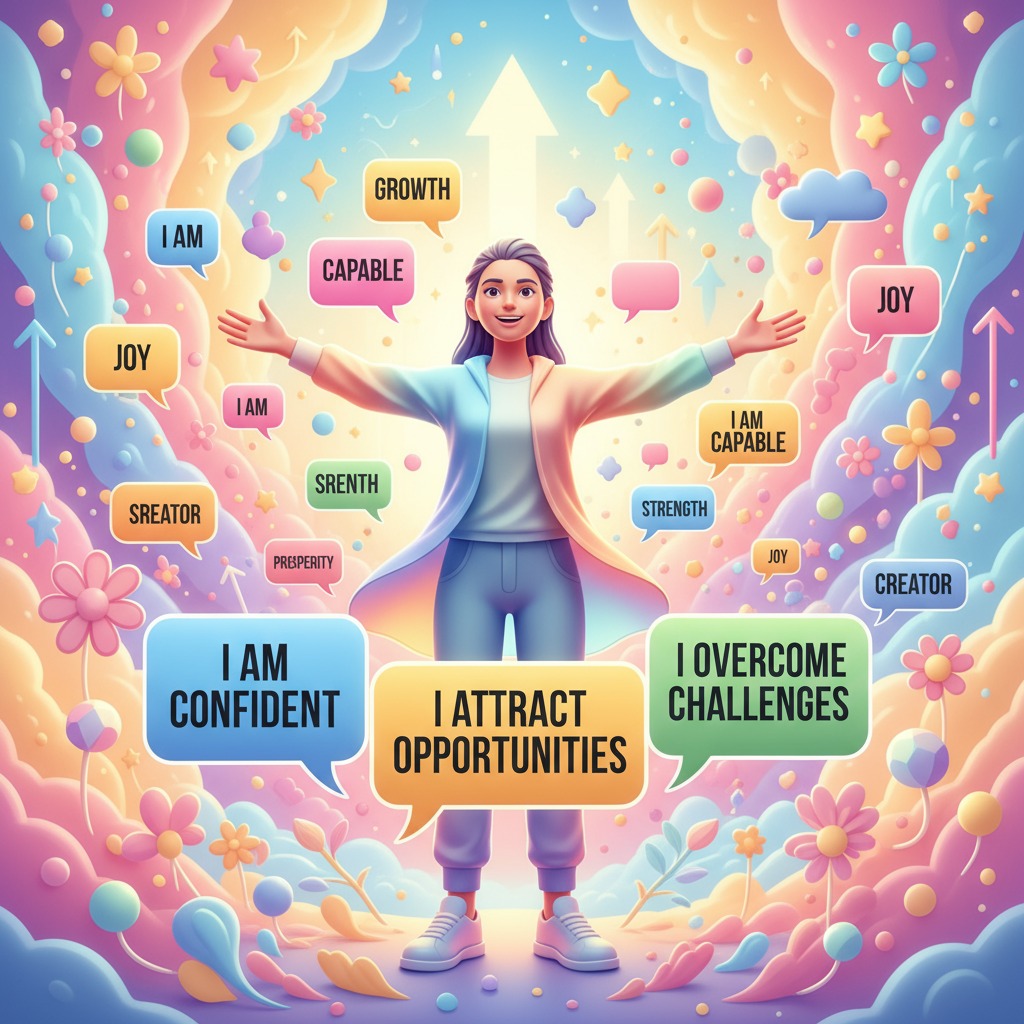
Daily affirmations are short, positive statements that affirm your belief in your abilities and potential. They work by directly addressing the inner dialogue that often sabotages success. Many people carry limiting beliefs, such as “I am not good enough” or “I always fail,” which operate quietly in the background of the mind. Over time, these beliefs shape behavior and create self-fulfilling prophecies. Affirmations break this cycle by replacing negative self-talk with empowering messages that strengthen self-belief.
The psychological impact of affirmations lies in their repetition. By stating a belief daily, whether spoken aloud or written in a journal, you train the subconscious mind to accept it as truth. The subconscious does not argue with repetition—it absorbs what it hears and gradually shifts your identity to align with those beliefs. For example, repeating “I am confident and capable” every morning conditions your mind to look for evidence of confidence and capability in your daily life.
When paired with visualization for success, affirmations act like verbal anchors. Visualization provides the image of success, while affirmations reinforce it with language. Together, they create a multi-sensory experience that is far more powerful than either practice alone. If you visualize yourself giving a confident presentation and at the same time affirm “I speak with clarity and confidence,” the message to your subconscious becomes much stronger. Over time, this dual reinforcement transforms both how you think and how you act.
Practical examples of affirmations include statements like “I attract opportunities that align with my goals,” “I am disciplined and consistent in my efforts,” or “I am resilient and overcome challenges with ease.” The key is to phrase affirmations in the present tense, as if the reality you desire already exists. This aligns with the brain’s natural tendency to respond more strongly to current states rather than future hopes.
The Power of Daily Meditation
Meditation is the third pillar of this transformative practice. It is often misunderstood as merely sitting quietly or emptying the mind, but its true essence lies in cultivating focus, presence, and awareness. In the context of visualization for success, meditation acts as the foundation. A distracted mind cannot visualize effectively, and a restless mind struggles to accept affirmations deeply. Meditation quiets mental chatter, reduces stress, and sharpens concentration, creating the ideal mental environment for visualization for success and affirmations to thrive.
The impact of meditation on the brain is well documented. Regular meditation has been shown to increase gray matter density in areas related to focus, memory, and emotional regulation. It reduces activity in the amygdala, the part of the brain associated with fear and anxiety, making you more resilient to stress. This means that when you meditate daily, you not only strengthen your ability to focus during visualization but also build emotional stability that supports your journey toward success.
Integrating meditation into your routine does not require hours of practice. Even five to ten minutes each morning can make a difference. A simple mindfulness meditation where you focus on your breath allows your mind to settle, creating mental clarity. Once calm, you can transition into visualization for success, making the practice more vivid and impactful. Similarly, an evening meditation that combines gratitude with visualization helps reinforce progress and keeps your goals fresh in your mind before sleep.
8 Powerful Visualization Techniques
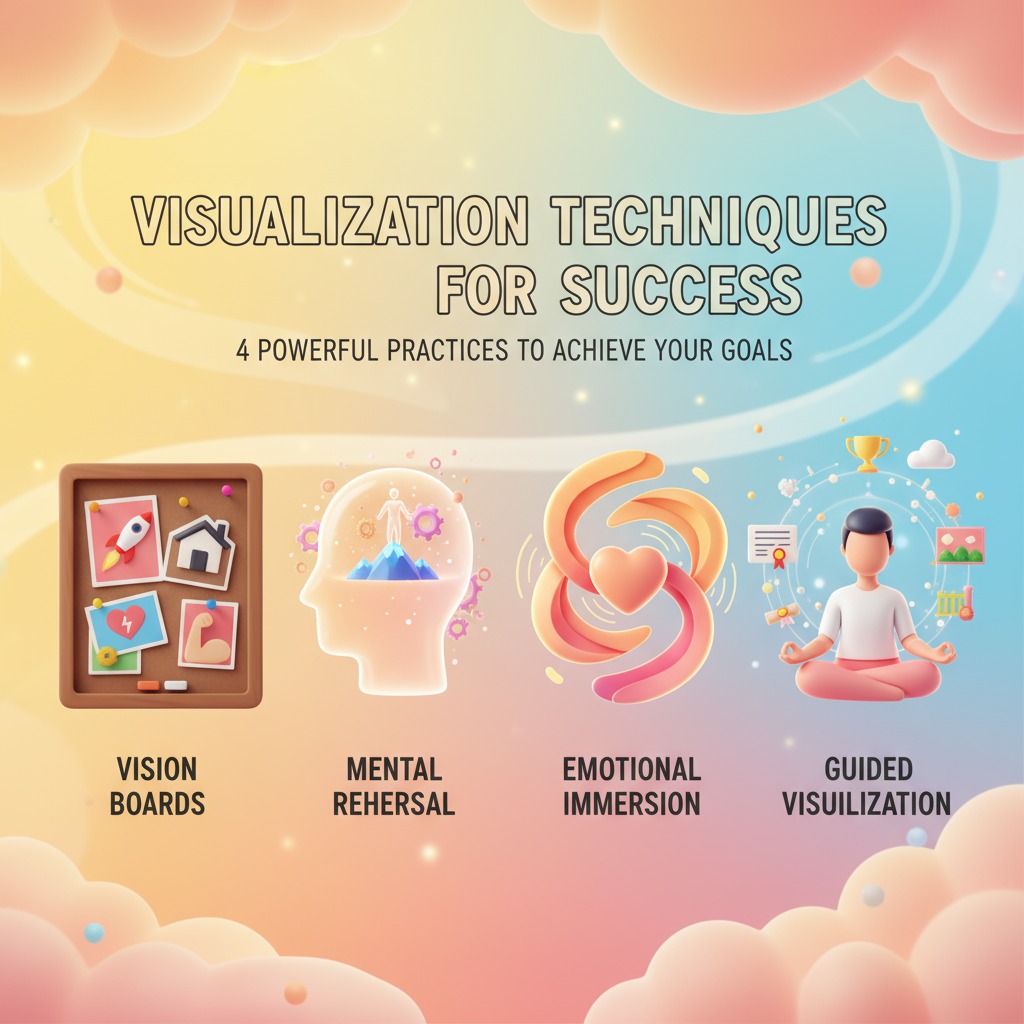
Technique 1: Vision Boards for Constant Goal Reinforcement
One of the most popular and effective ways to practice visualization for success is by creating vision boards. These boards can be physical or digital collections of images, quotes, and symbols that represent your goals. When you see a picture of your dream house, a quote that inspires you, or an image of someone embodying the qualities you admire, your subconscious begins to accept that vision as part of your reality.
The strength of vision boards lies in repetition and exposure. Placing the board somewhere you look daily, such as your bedroom wall or workspace, ensures that your goals stay fresh in your mind. This daily reminder reduces distractions and keeps you focused on what matters most. Many successful people, including athletes and entrepreneurs, have used vision boards to stay aligned with their ambitions, turning distant dreams into achievable milestones.
Technique 2: Mental Rehearsal for Building Confidence in Action
While vision boards focus on outcomes, mental rehearsal emphasizes the process of getting there. Instead of just seeing yourself at the finish line, you visualize the steps required to achieve success. For instance, if your goal is to run a marathon, you imagine yourself consistently training, maintaining discipline, overcoming fatigue, and finally crossing the finish line.
This mental rehearsal conditions your brain to experience the journey in advance, making the actions feel more natural when you perform them in reality. Professional athletes often rely on this technique, rehearsing every movement in their minds before executing it on the field. By practicing not just the victory but also the effort, you strengthen your belief that success is within reach and train your mind to handle challenges with confidence.
Technique 3: Emotional Immersion for Intensifying Visualization
Visualization for success becomes far more powerful when you engage your emotions. The subconscious mind responds strongly to feelings, and adding emotional depth transforms mental images into compelling experiences. Instead of simply seeing yourself achieve your goal, imagine the pride, joy, and relief that comes with it. If you are working toward career success, feel the satisfaction of receiving recognition, the excitement of achieving financial freedom, and the pride of proving your capabilities. This emotional immersion blurs the line between imagination and reality because the brain struggles to distinguish between vividly felt experiences and actual ones. The more you immerse yourself in these emotions, the stronger your subconscious drive becomes, pushing you to take consistent action toward your vision.
Technique 4: Guided Visualization for Deeper Focus
For those who struggle to stay focused during visualization for success, guided sessions provide structured support. These often come in the form of audio recordings led by coaches, psychologists, or meditation experts. Guided visualization for success helps you relax, clear your mind, and concentrate fully on the imagery being described.
Because you are being led step by step, the process feels more immersive and natural. This technique is especially useful for beginners who may find it difficult to create vivid imagery on their own. By following a guide’s instructions, you experience a richer, more detailed visualization that activates your imagination more powerfully. Over time, guided sessions can train you to visualize independently with the same level of focus and clarity.
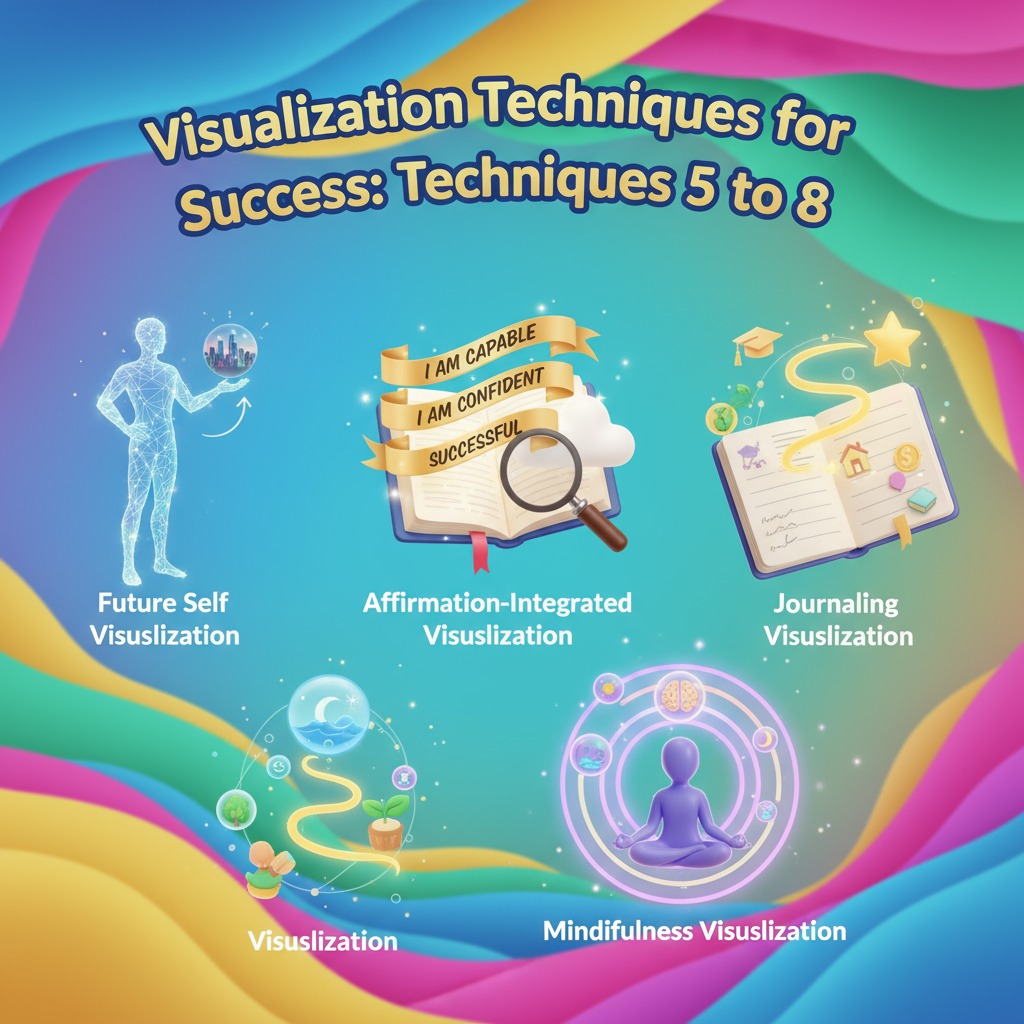
Technique 5: Future Self Visualization to Align with Growth
Another effective method is future self-visualization, where you imagine the version of yourself who has already achieved your goals. Picture yourself living the life you desire, embodying the habits, confidence, and discipline needed to maintain that success. For example, if you want to build a successful business, visualize yourself as the entrepreneur who has already done it—confidently managing a team, making wise decisions, and enjoying the rewards of your efforts.
This technique bridges the gap between where you are and where you want to be. By seeing yourself as your future self, you naturally begin to align your present actions with that identity. It shifts your mindset from “I want to be successful” to “I am becoming the successful version of myself,” making success feel inevitable rather than distant.
Technique 6: Affirmation-Integrated Visualization for Double Impact
Combining affirmations with visualization for success creates a layered and powerful experience. While you are visualizing your success, you reinforce the imagery with spoken or written affirmations. For example, if you are visualizing yourself excelling at work, you might repeat affirmations such as “I am skilled, confident, and successful in my career.” This integration works on both visual and auditory levels, allowing your subconscious to absorb the message more deeply. The images show you what success looks like, while the affirmations tell you that it is already yours. This dual reinforcement accelerates belief formation, reduces doubt, and strengthens your confidence. When practiced daily, affirmation-integrated visualization reshapes both your mindset and your behavior, moving you steadily closer to your goals.
Technique 7: Journaling Visualization for Reinforcement
Writing is another powerful way to make visualization for success more real. Journaling your visions in the present tense turns them into vivid, lived experiences on paper. Instead of writing, “I hope to achieve success,” you write, “I am living a successful and fulfilling life where I feel proud and free.” This practice engages the conscious and subconscious mind simultaneously.
By putting words to your visions, you clarify your goals and create a tangible record of your desires. Journaling also allows you to track your progress over time, giving you a sense of achievement as you move closer to your vision. Many people find that combining visualization with journaling makes their goals feel less like abstract dreams and more like unfolding realities.
Technique 8: Mindfulness Visualization for Balance and Clarity
Mindfulness visualization for success blends the power of presence with the imagination of future success. You begin by grounding yourself in the present moment, focusing on your breathing, your body, and your surroundings. Once you are calm and centered, you gradually shift into imagining your vision with clarity and focus. This technique ensures that your visualization is not rooted in anxiety or restlessness but in a state of peace and awareness.
For example, if your goal is to build a healthier lifestyle, mindfulness visualization allows you to first feel gratitude for your current body before imagining the stronger, healthier version of yourself. By combining mindfulness with visualization, you remain balanced, focused, and free from distractions, creating a clear mental pathway toward success.
Creating a Daily Routine for Maximum Impact
Visualization for success only produces lasting results when practiced consistently. A scattered or irregular approach weakens its impact, while a structured daily routine builds momentum. The ideal routine integrates meditation, visualization, and affirmations into a single flow.
A simple yet powerful routine begins in the morning. Start with five to ten minutes of meditation to calm your mind and center your energy. Once relaxed, move into visualization by picturing your goals in vivid detail. Imagine them as if they are already real, and immerse yourself in the emotions of achievement. After visualization for success, recite your affirmations out loud, reinforcing your images with powerful language. In the evening, spend ten minutes journaling about your visualized goals, writing in the present tense and reflecting on your daily progress.
The timing of your practice matters. Morning routines set the tone for the day, filling your mind with positivity and focus. Evening routines reinforce progress and prepare your subconscious to process your goals during sleep. Consistency is more important than duration. Even short sessions practiced daily are more effective than long sessions done sporadically.
To stay consistent, pair your practice with existing habits. For example, meditate and visualize after brushing your teeth in the morning or before bed at night. Set reminders on your phone if needed, and create a dedicated space in your home for practice. Over time, this routine becomes second nature, and the benefits compound.
Common Mistakes to Avoid
While visualization for success is a powerful tool, many people make mistakes that reduce its effectiveness. One of the most common errors is visualizing without emotion. Simply imagining an image without feeling does not engage the subconscious fully. Emotion is the fuel that makes visualization powerful, so it is essential to immerse yourself in the feelings of success.
Another mistake is neglecting affirmations or meditation. Visualization for success is strongest when supported by affirmations that reinforce belief and meditation that sharpens focus. Without these, visualization can feel shallow or unfocused.
Inconsistency is also a major obstacle. Many people try visualization for success for a few days, expect instant results, and then give up when nothing happens quickly. The truth is that visualization builds momentum gradually. Like physical training, it requires time, patience, and repetition. Impatience can cause frustration, which undermines the practice.
Finally, some people approach visualization as if it can replace action. Visualization for success is not a substitute for effort—it is a complement. Its role is to prepare the mind, boost confidence, and create clarity, but the actual steps toward success must still be taken. When used as a partner to hard work, visualization becomes truly powerful.
Real-Life Examples and Success Stories
The effectiveness of visualization for success is evident in the stories of achievers across fields. Elite athletes are perhaps the most famous practitioners. Michael Phelps, the Olympic swimmer, visualized every detail of his races, from the strokes he would take to how he would respond if his goggles filled with water. This mental preparation gave him an edge that contributed to his record-breaking performances. Serena Williams also credits visualization as part of her training, imagining herself winning matches long before she stepped on the court.
In entertainment and business, similar stories emerge. Jim Carrey famously wrote himself a check for ten million dollars for “acting services rendered” at a time when he was struggling financially. He visualized success consistently, and years later, he received a movie role that paid him exactly that amount. Oprah Winfrey has also spoken about the power of intention and visualization in creating the life she dreamed of.
Ordinary individuals also benefit from visualization. Students have used it to overcome exam anxiety and perform better in academics. Professionals visualize themselves excelling in interviews and presentations, which boosts confidence and increases their chances of success. Entrepreneurs visualize business growth, aligning their strategies and actions with the mental image of success. These examples demonstrate that visualization is not just for the famous; it is a tool available to anyone willing to practice consistently.
Benefits of Visualization for Success
The benefits of visualization for success are wide-ranging. By regularly imagining positive outcomes, you accelerate goal achievement because your mind and body begin to act in alignment with your vision. You develop sharper focus, reducing distractions and increasing your ability to concentrate on what matters.
Visualization for success also boosts confidence. When you see yourself succeeding repeatedly in your mind, you begin to trust in your abilities. This confidence translates into real-world performance, helping you take bold steps toward your goals. It builds resilience by preparing you mentally for setbacks. When challenges arise, you respond with calm and determination rather than fear.
Beyond goal achievement, visualization for success improves overall well-being. It reduces stress by shifting your focus from worry to possibility. It improves mood and creates a sense of empowerment, reminding you that you are in control of your journey. Over time, these benefits create a virtuous cycle where mental clarity, belief, and action feed into one another, bringing success closer every day.

FAQs
1. How long does it take to see results from visualization?
Results depend on consistency and clarity. Many people notice improved focus and confidence within a few days, while achieving bigger goals may take several weeks or months. Regular practice accelerates results.
2. Can visualization replace hard work?
No, visualization alone cannot bring success. It prepares your mind, boosts confidence, and motivates you, but you still need consistent action to turn your vision into reality.
3. How many affirmations should I repeat daily?
Repeating 3–5 powerful affirmations daily is ideal. The effectiveness comes from focus, emotion, and belief, not just the number of repetitions.
4. Is meditation necessary for visualization?
Meditation is not mandatory but highly recommended. It calms the mind, improves focus, and makes your visualizations more vivid and effective.
5. What is the best time of day to visualize?
Early morning and before bedtime are most effective, as the mind is calm and receptive. However, the key is practicing consistently at a time that fits your routine.
Conclusion
Visualization for success is more than just imagining your goals—it is a powerful mental practice that combines clarity, focus, and emotional engagement to help you achieve your dreams faster. By visualizing your desired outcomes, you create a mental blueprint that guides your actions, strengthens your confidence, and aligns your mindset with your objectives. When combined with daily affirmations, this practice reinforces self-belief, replaces doubt with positivity, and keeps you motivated even during challenges. Adding meditation into the mix amplifies these benefits by calming the mind, enhancing concentration, and making your visualizations more vivid and effective.
The eight techniques outlined—from vision boards and mental rehearsal to emotional immersion, guided sessions, future self-visualization, affirmation integration, journaling, and mindfulness visualization for success —offer multiple ways to harness the brain’s natural ability to respond to imagined experiences. Each technique works in a unique way, but together they create a comprehensive framework that turns abstract dreams into achievable reality.
The key to success lies in consistency, patience, and emotional engagement. Visualization for success is not about wishful thinking or instant results; it is about training your mind, reinforcing positive habits, and steadily aligning your thoughts, emotions, and actions with your goals. As you practice daily, you will notice subtle changes in your mindset, improved focus, increased resilience, and a growing belief in your ability to achieve anything you set out to do.
Start small, choose a few techniques that resonate with you, and gradually build a daily routine. Over time, these practices become second nature, creating a mindset where success feels natural and attainable. By integrating visualization for success, affirmations, and meditation into your life, you are not just dreaming—you are actively shaping your future, making every step toward your goals more intentional, confident, and powerful.
Remember, the journey to success begins in your mind. The clearer your vision, the stronger your belief, and the more consistent your practice, the faster and more effortlessly you will turn your dreams into reality. Begin today, stay committed, and watch as the life you imagine slowly unfolds into the life you live.