

Table of Contents
1. Introduction – The Power of Creative Thinking Exercises
Creative thinking exercises are powerful tools that reshape how the human mind perceives, interprets, and responds to challenges. In an age defined by rapid change, automation, and competition, creativity has evolved from being an artistic talent into a critical life skill. Whether you’re a professional, entrepreneur, student, or educator, your ability to think creatively determines your capacity to innovate, adapt, and thrive.
These creative thinking exercises sharpen your mental flexibility, improve decision-making, and cultivate innovative approaches to everyday problems. When practiced consistently, they act as effective brain training routines that stimulate neural growth, enhance memory, and strengthen problem-solving abilities. Much like physical exercise shapes the body, creative thinking workouts condition the mind to become more agile and resilient.
Moreover, these exercises promote innovation habits, helping individuals embrace curiosity, question norms, and explore unconventional perspectives. They nurture a sense of wonder, allowing the mind to discover new pathways even in familiar circumstances. For mental wellness, creative exercises reduce stress, improve focus, and build emotional balance—forming a foundation for both personal and professional growth.
Imagine facing obstacles not with anxiety, but with excitement. That’s the power of a creative mindset—a mindset built and sustained through daily creative thinking exercises that ignite imagination, curiosity, and confidence.
2. Understanding the Core of Creative Thinking Exercises
Creative thinking exercises go beyond brainstorming or artistic expression—they engage your brain in a structured process of divergent and convergent thinking. Divergent thinking helps you generate multiple ideas, while convergent thinking helps you refine and implement them effectively. Together, they stimulate brain training by strengthening neural pathways responsible for logic, emotion, and creativity.
At their core, creative thinking exercises rely on neuroplasticity—the brain’s ability to reorganize itself by forming new neural connections. When you expose yourself to new ideas, environments, or challenges, your brain adapts, learns, and grows stronger. This biological process explains why creativity can be developed by anyone, regardless of age or background.
Creativity also flourishes through mindset. A growth mindset, which values effort and learning over perfection, is essential to building innovation habits. People with a growth mindset view mistakes as lessons, not failures. By practicing creative thinking exercises daily, you train yourself to embrace uncertainty, explore multiple perspectives, and take calculated risks—all of which fuel innovation.
Additionally, creativity thrives on balance—between logic and imagination, focus and freedom, structure and play. Integrating creative thinking exercises into your daily life nurtures this balance, helping you make better decisions, adapt faster, and discover innovative solutions in complex situations.
In short, creative thinking is not about innate talent—it’s a muscle built through consistency, reflection, and openness to experimentation.
3. The Connection Between Creative Thinking Exercises, Brain Training, and Problem-Solving
Creative thinking exercises directly enhance cognitive function through systematic brain training. When you challenge your brain to approach problems differently, you activate both hemispheres—the logical left and the imaginative right. This balanced brain activity results in sharper focus, improved adaptability, and enhanced decision-making.
Through regular creative thinking exercises, your brain learns to identify hidden connections between unrelated ideas—a process called associative thinking. This not only boosts innovation but also improves emotional intelligence, as it teaches you to understand multiple viewpoints before making a decision.
Problem-solving becomes easier when creativity meets logic. For instance, if a team struggles to innovate a product, brainstorming using “What if” questions or mind mapping can unlock new possibilities. Similarly, brain training exercises such as pattern recognition or visual association enhance memory recall and critical analysis, essential for solving real-world challenges.
Moreover, innovation habits developed through creativity lead to a proactive mindset. Instead of reacting to problems, you anticipate them, strategize solutions, and adapt quickly. Neuroscience research confirms that people who engage in creative activities experience higher dopamine levels—improving motivation, learning, and cognitive flexibility.
Simply put, creative thinking exercises bridge the gap between imagination and execution. They transform abstract ideas into actionable strategies, leading to better decisions, improved performance, and lasting personal growth.

4. 9 Proven Daily Creative Thinking Exercises to Develop Innovation Habits
Creative thinking exercises are powerful tools that help you reprogram your brain to see opportunities instead of obstacles. Practicing these exercises daily nurtures innovation habits, enhances brain training, and sharpens your problem-solving abilities. Each activity trains different parts of your mind—logic, emotion, creativity, and memory—helping you stay mentally agile and innovative in every situation. Below are nine highly effective creative thinking exercises that can become part of your daily routine for continuous growth and innovation.
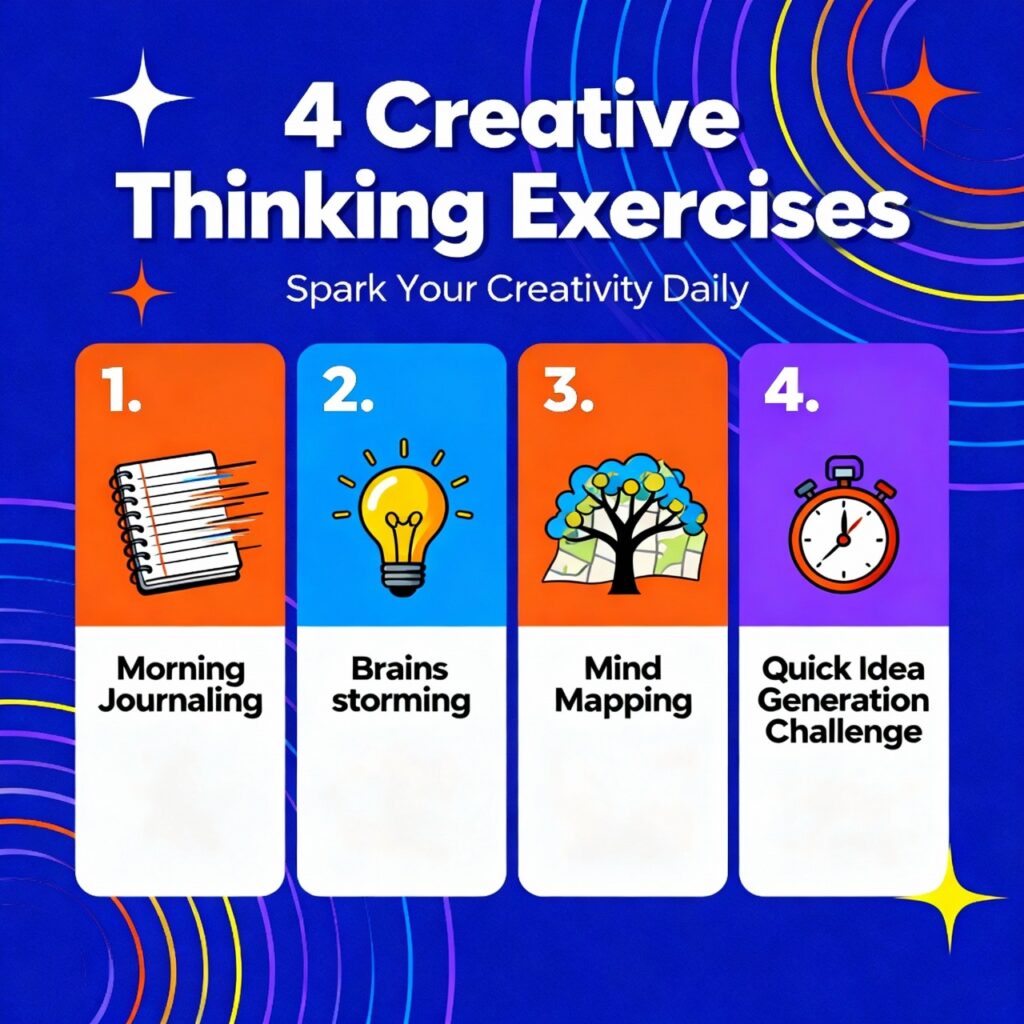
1. Morning Journaling for Fresh Perspectives
Creative thinking exercises begin best in the morning when your mind is clear and curious. Spend 10–15 minutes journaling about your dreams, thoughts, emotions, or new ideas that arise as you wake up. This process clears mental clutter and activates your subconscious creativity.
Journaling as a creative thinking exercise enhances emotional intelligence and self-awareness. It helps identify thought patterns, uncover innovative insights, and strengthen problem-solving abilities. Over time, morning journaling fosters consistent innovation habits by encouraging reflection and self-expression.
To elevate this exercise, try “stream of consciousness writing” where you write continuously without editing or judgment. This technique taps into your intuitive thinking and releases creative energy that fuels productive brain training.
2. “What If” Brainstorming Sessions
One of the most stimulating creative thinking exercises is asking “What if?” questions. This method challenges your brain to step outside traditional assumptions and view problems from new angles. For instance, “What if I approached this project differently?” or “What if this limitation didn’t exist?”
These questions push boundaries and spark innovative ideas by forcing your brain to explore alternative realities. Such exercises are vital for building long-term innovation habits since they enhance mental flexibility and reduce fear of failure.
To make this more impactful, set aside five minutes daily to question something routine—your workflow, a habit, or a decision. Over time, this consistent practice transforms the way you think, making your creative problem-solving faster and sharper.
3. Mind Mapping for Complex Ideas
Mind mapping is a visual form of creative thinking exercise that helps you connect ideas clearly. Start with a central theme in the middle of a page—such as a project, goal, or problem—and branch out into subtopics, associations, and possible outcomes.
This creative thinking exercise allows your mind to structure chaos and uncover connections that linear thinking often misses. It stimulates both hemispheres of the brain—logic and creativity—making it an excellent brain training tool for improving memory, clarity, and focus.
Mind mapping can also strengthen innovation habits by promoting organized thinking. Try using colored pens or digital mind-mapping tools like Miro or Mind for visual stimulation and deeper engagement.
4. The 10-Minute Brainstorm Challenge
Among all creative thinking exercises, this one is simple yet powerful. Set a timer for ten minutes and write down as many ideas as possible related to a specific challenge or goal—without stopping or filtering.
This rapid ideation method trains your mind to overcome perfectionism and fear of judgment, two major creativity blockers. It encourages spontaneous thought generation and builds confidence in your intuitive decision-making.
Over time, practicing this challenge daily enhances your mental flexibility, making idea generation effortless. It strengthens your innovation habits, helping you produce high-quality ideas under time pressure—a key skill in both business and personal growth.
5. Observation Walks for Mindful Awareness
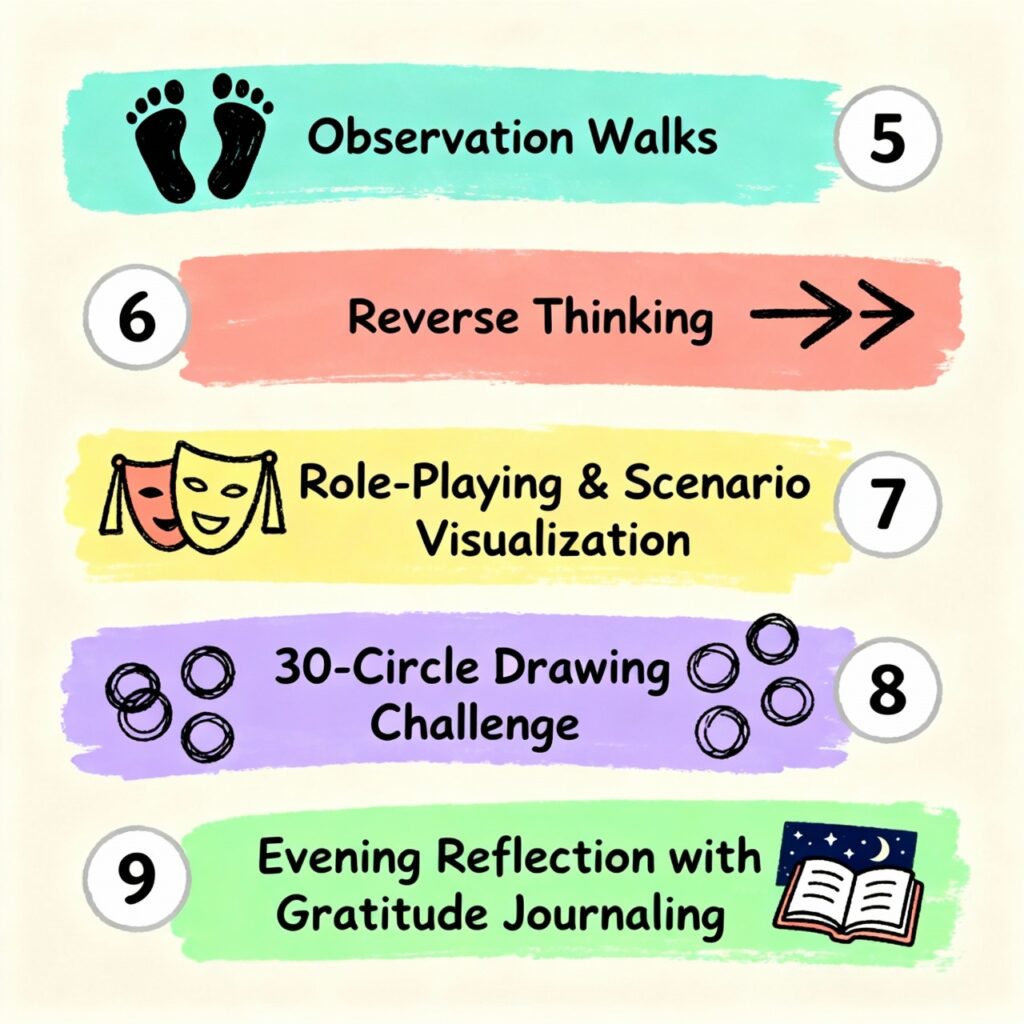
Observation walks are among the most enjoyable creative thinking exercises for brain relaxation and inspiration. Take a short walk outside—whether in your neighborhood or a park—and consciously observe the details around you: the colors of leaves, sounds of traffic, or shapes of buildings.
This mindfulness-based exercise enhances sensory awareness and promotes mental calmness, allowing your subconscious mind to process thoughts creatively. Often, new ideas and insights emerge when you’re relaxed and detached from problem-solving.
Observation walks are excellent for brain training as they connect mindfulness with creativity. They encourage mental balance, reduce stress, and improve focus—all essential for sustained innovation habits.
6. Reverse Thinking for Deeper Analysis
Reverse thinking is one of the most unconventional yet powerful creative thinking exercises. Instead of solving a problem directly, think about how you could make it worse. For example, if you want to improve teamwork, ask, “How could I destroy teamwork completely?”
By identifying negative actions, you uncover critical insights and hidden patterns that help prevent mistakes. This approach enhances analytical depth and encourages lateral thinking—an essential skill in innovation and strategic decision-making.
Reverse thinking develops advanced brain training by engaging critical reasoning and imagination simultaneously. It helps dismantle rigid thinking patterns, leading to clearer and more effective solutions.
7. Role-Playing and Scenario Visualization
Creative thinking exercises like role-playing help expand empathy and perspective. Imagine yourself in another person’s shoes—a customer, colleague, or even a competitor—and think about how they would handle a specific challenge or opportunity.
Visualization adds another layer of depth. By mentally simulating scenarios, you train your brain to anticipate outcomes and prepare for complex situations. This mental rehearsal strengthens both creativity and decision-making, essential for leadership and teamwork.
Regularly practicing role-playing builds strong innovation habits because it combines emotional understanding with strategic foresight. It prepares your mind for real-world adaptability and enhances your confidence in uncertain situations.
8. The 30-Circle Drawing Exercise
The 30-circle challenge is one of the most exciting and fast-paced creative thinking exercises. Draw 30 empty circles on a blank sheet and give yourself three minutes to turn each circle into something unique—like a clock, face, sun, or planet.
This playful yet challenging task pushes your brain to think visually and rapidly, improving cognitive flexibility and imagination. It strengthens neural pathways linked to creativity and improves your brain’s ability to make quick associations.
Doing this exercise daily builds innovation habits that rely on speed, flexibility, and originality. Over time, you’ll notice a significant improvement in how quickly you generate ideas in professional and personal settings.
9. Evening Reflection and Gratitude Journaling
End your day with reflection—the perfect complement to morning journaling. This creative thinking exercise involves revisiting your day’s thoughts, creative moments, and lessons learned. Then, write down three things you are grateful for.
Evening reflection promotes emotional balance, mental clarity, and self-compassion. It reinforces positive thinking, which directly enhances your creative mindset. Gratitude also helps your brain associate creativity with fulfillment rather than stress.
This exercise strengthens innovation habits by fostering a calm and appreciative mindset. It prepares your brain for better rest and primes your subconscious for fresh ideas upon waking. Over time, it creates a continuous loop of creative thinking, reflection, and renewal.
5. Overcoming Barriers to Creativity and Mental Flexibility
Even the most imaginative individuals encounter barriers such as fear of failure, perfectionism, overthinking, or mental exhaustion. These obstacles can block creative flow and make it difficult to think freely. However, with awareness and consistent practice, they can be overcome.
One of the most common challenges is the fear of judgment. Many people suppress their ideas because they worry about criticism or rejection. Engaging in low-pressure creative outlets like doodling, journaling, or freewriting helps reduce this fear by allowing you to express ideas without consequence. The goal is not perfection—it’s exploration. Over time, these small acts build creative confidence and mental resilience.
Perfectionism is another powerful barrier. When people strive for flawless results, they often hesitate to begin. To counter this, it’s important to embrace the mindset that creativity is a process of trial and discovery. Open-ended exercises—such as spontaneous brainstorming or abstract art—encourage experimentation and help you focus on progress rather than outcomes. This mental flexibility strengthens problem-solving and emotional adaptability.
Mental fatigue and information overload can also drain inspiration. In today’s digital world, constant input leaves little room for creative processing. Taking short, mindful breaks—like walking, deep breathing, or meditating—restores balance and recharges the mind. Even simple structured brain activities like pattern puzzles, logic games, or storytelling exercises can reset focus and promote clarity.
A stimulating environment is equally vital. Surround yourself with people, places, and content that inspire curiosity. Reading diverse genres, exploring different art forms, or engaging in creative conversations opens your mind to new possibilities. Stepping outside your daily routine refreshes your perspective and triggers innovative ideas.
By identifying these mental and emotional barriers early and addressing them through patience, mindfulness, and practice, you create an internal ecosystem that supports creativity, flexibility, and sustained innovation.
6. Integrating Creative Thinking Exercises into Daily Life
Integrating creative thinking exercises into your daily life doesn’t require a huge time commitment—it requires intention and consistency. When practiced regularly, these exercises transform routine moments into opportunities for innovation, self-reflection, and mental renewal. The key lies in embedding creativity into everyday tasks so that it becomes second nature rather than a scheduled activity.
Begin your day with a creative warm-up. Spend ten minutes journaling ideas, sketching visuals, or writing free associations about what inspires you. This morning ritual activates your brain’s creative centers and prepares you for problem-solving throughout the day. During lunch breaks, try observation walks—notice patterns, colors, or sounds around you. Such small acts stimulate mindfulness and open your mind to fresh perspectives.
Technology can also be a powerful ally in nurturing creativity. Use digital tools like Notion, Evernote, or Miro to collect spontaneous ideas, make mood boards, or build visual maps of your thoughts. Collaboration further amplifies this process—discussing ideas with colleagues or friends introduces new viewpoints and challenges assumptions, both of which are vital for innovation habits.
Even short creative sessions before bed can leave lasting effects. Doodling, reflective writing, or mental visualization calm your mind and prepare it for imaginative dreams, which often spark breakthrough ideas. By weaving these habits into your routine, you not only sharpen your problem-solving abilities but also enhance emotional balance and cognitive flexibility.
The key takeaway is that creativity thrives on consistency, not intensity. When you make creative thinking exercises a daily ritual, your brain begins to adapt—forming stronger neural connections that make creativity, innovation, and adaptability a natural part of who you are.
7. The Role of Mindfulness in Enhancing Creative Thinking Exercises
Mindfulness and creativity are deeply interconnected—one cultivates focus, while the other nurtures imagination. Together, they form the foundation for innovative thinking and emotional stability. When you combine mindfulness with creative thinking exercises, you train your mind to remain present, calm, and receptive to new ideas.
Mindfulness practices like deep breathing, meditation, or mindful observation help quiet mental noise and reduce distractions. A focused mind processes information more efficiently, leading to improved clarity and original insights. For instance, a few minutes of mindful breathing before brainstorming can center your attention, allowing innovative ideas to surface effortlessly.
Scientific studies show that mindfulness activates the prefrontal cortex—the brain region responsible for problem-solving and creativity. By lowering stress levels and enhancing awareness, mindfulness supports a state known as “flow,” where thoughts and actions blend seamlessly, producing inspired results. This is why many leaders, artists, and thinkers integrate mindfulness into their daily routines—it helps them remain both grounded and imaginative.
You can also practice mindful creativity through activities like mindful drawing, journaling, or sensory observation. These practices teach you to engage fully with the present moment, turning simple experiences into sources of inspiration. Over time, this balance between awareness and imagination enhances emotional intelligence and mental flexibility.
Ultimately, mindfulness amplifies the benefits of creative thinking exercises by stabilizing emotions, deepening focus, and freeing the mind from self-criticism. When calmness meets curiosity, creativity flows naturally. This fusion not only elevates your problem-solving skills but also promotes inner peace, clarity, and long-term mental well-being.

8. Real-Life Examples of Creative Thinking Exercises in Action
Creative thinking exercises have played a vital role in shaping some of the world’s greatest innovations and breakthroughs. Throughout history, visionary thinkers, scientists, and creators have relied on these practices to push boundaries, generate unique ideas, and approach challenges with fresh perspectives.
Albert Einstein often used creative thinking exercises like mental visualization—what he called “thought experiments.” He imagined himself riding alongside beams of light to understand how time and space interact. This powerful mental practice led to his revolutionary theory of relativity, proving how imagination can transform abstract thinking into world-changing discoveries.
Steve Jobs is another perfect example of how creative thinking exercises influence innovation habits. He regularly practiced mindfulness and simplicity, which guided Apple’s philosophy of user-friendly design. Jobs encouraged his teams to look beyond traditional solutions and focus on the emotional experience of users—a habit that became central to Apple’s creative culture.
Walt Disney developed one of the most structured creative thinking exercises known today—the “Three Room Method.” He divided his thought process into three roles: the Dreamer (for imagination), the Realist (for practical planning), and the Critic (for refinement). This method allowed him to transform wild ideas into achievable, high-quality results, setting a timeless example of balanced creativity.
Modern companies such as Google, IDEO, and Pixar also integrate creative thinking exercises into their daily workflows. They organize brainstorming sessions, innovation labs, and collaborative design sprints where employees are encouraged to think freely, experiment boldly, and embrace failure as part of the creative process.
These examples prove that creativity is not accidental—it’s intentional. Through consistent use of creative thinking exercises, individuals and organizations build cultures of innovation, curiosity, and adaptability. Whether used for personal growth or business transformation, these exercises empower people to think beyond the obvious and turn imagination into meaningful impact.
9. Conclusion
Creative thinking exercises are far more than occasional brain workouts—they are lifelong tools for personal evolution, emotional wellness, and professional growth. When practiced regularly, creative thinking exercises don’t just make you more imaginative; they reshape how you approach challenges, communicate with others, and design your life with purpose and vision.
Consistent brain training through creative thinking exercises helps strengthen neural pathways responsible for flexibility, innovation, and strategic decision-making. Over time, these practices cultivate sharper problem-solving skills and the confidence to navigate uncertainty with calmness and creativity. Whether you’re an entrepreneur brainstorming new ideas, a student exploring multiple possibilities, or a professional managing complex projects, the benefits of creative thinking exercises ripple across every dimension of life.
One of the greatest long-term benefits of these exercises is enhanced emotional intelligence. When your mind learns to see challenges as opportunities rather than obstacles, you respond with empathy, patience, and optimism. This mindset not only fuels innovation but also strengthens relationships—both personal and professional—making collaboration, communication, and understanding more effective and rewarding.
Incorporating innovation habits into your daily routine also supports mental wellness. Engaging your imagination through creative thinking exercises reduces stress, builds resilience, and provides a healthy outlet for self-expression. Instead of being overwhelmed by repetitive tasks or routines, you begin to find inspiration in them—turning ordinary moments into opportunities for self-improvement and creative exploration.
To truly master creativity, think of it as a discipline rather than an occasional spark. Make reflection, observation, and curiosity part of your everyday rhythm. Keep a creativity journal, explore unfamiliar environments, and allow yourself to experiment without fear of failure. Each small act of imagination contributes to a lifelong journey of self-discovery, innovation, and confidence.
Ultimately, creativity is not a gift reserved for artists or inventors—it’s a way of thinking that anyone can cultivate. The more you engage with creative thinking exercises, the more naturally your mind learns to connect diverse ideas, adapt to change, and visualize better possibilities.
In the end, creativity empowers you to live fully—to lead with vision, solve with clarity, and dream without limits. It’s not just about thinking differently; it’s about thinking expansively, fearlessly, and authentically. By making creative thinking exercises a consistent part of your daily life, you unlock the boundless potential of your mind—and that becomes the true foundation of a fulfilled, innovative, and meaningful life.