

Table of Contents
Introduction
How to Build Mental Strength is a question more and more people are asking today. In a world filled with constant pressure, competition, and uncertainty, mental resilience has become as important as physical health. Whether it’s students preparing for exams, professionals chasing deadlines, or athletes striving for excellence, everyone faces stress that can either make or break them. Mental strength is what determines how effectively we manage stress and how consistently we perform at our peak.
At its core, mental strength isn’t about suppressing emotions or pretending to be tough. Instead, it is about creating the balance between emotional stability, rational decision-making, and consistent discipline. A strong mind allows you to bounce back from failures, manage stress before it overwhelms you, and unlock your potential for peak performance.
This blog explores the 11 proven practices to build mental strength that will not only help in stress management but also ensure sustainable success in both personal and professional life.
Understanding Mental Strength
How to Build Mental Strength begins with understanding what it actually means. Mental strength refers to the ability to regulate emotions, manage thoughts, and remain focused under pressure. It combines resilience, self-discipline, adaptability, and the courage to face challenges without giving up.
Unlike the idea of being “tough” or “hard,” mental strength is not about ignoring pain or forcing positivity. Instead, it is about developing emotional intelligence, creating balance, and building habits that protect mental wellness. A mentally strong person acknowledges difficulties but responds with clarity and composure rather than panic.
For example, a student facing exam stress doesn’t waste energy worrying about failure but instead channels energy into revision and smart planning. Similarly, an entrepreneur dealing with setbacks sees them as learning opportunities rather than dead ends. This mindset difference is what sets mentally strong individuals apart.
Why Building Mental Strength is Essential
How to Build Mental Strength is essential because modern life is full of challenges that test our patience and stability. Stress from studies, work, finances, or relationships can weaken focus, lower confidence, and drain energy. Without proper strategies, stress often leads to burnout, anxiety, or poor performance.
Strong mental habits act like armor against these pressures. For instance, when an athlete loses an important match, mental strength allows them to review mistakes, train harder, and return stronger. In professional settings, mental resilience helps employees stay calm under deadlines and deliver consistent results.
Scientific studies also confirm that mental strength improves stress management by lowering cortisol (the stress hormone) and increasing dopamine (the motivation hormone). Moreover, peak performance—whether in sports, academics, or work—is often achieved not by the most talented individuals but by those with the strongest mental discipline.

11 Proven Practices to Build Mental Strength
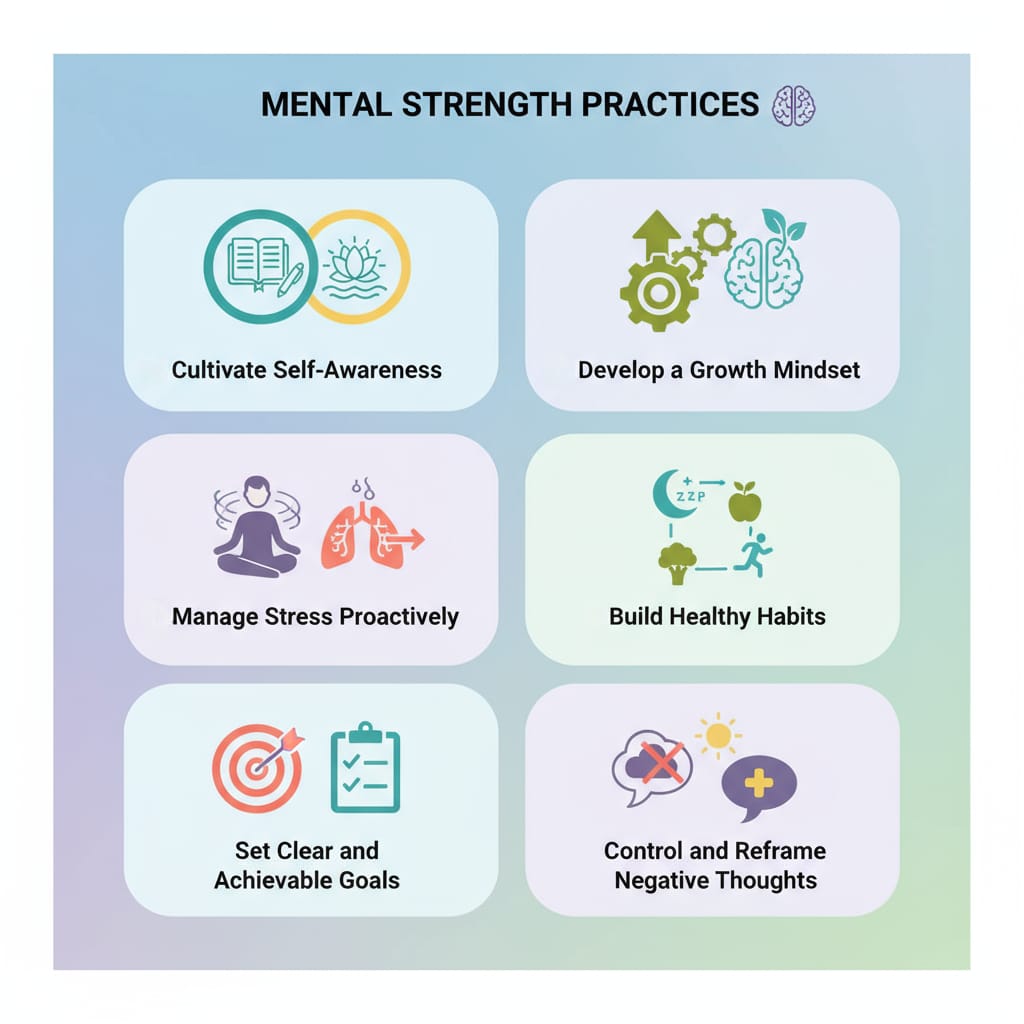
Practice 1: Cultivate Self-Awareness
How to Build Mental Strength starts with self-awareness. You cannot control what you don’t recognize. Self-awareness means understanding your triggers, emotions, and thought patterns.
Practical ways to build self-awareness include journaling, practicing mindfulness, and reflecting on daily experiences. For example, writing down stressful moments each day helps identify recurring patterns. Once you know your triggers, you can consciously change how you respond.
A working professional who notices that emails trigger anxiety may set specific times to check them instead of constantly reacting. This small shift creates focus and reduces unnecessary stress.
Practice 2: Develop a Growth Mindset
How to Build Mental Strength requires a growth mindset—the belief that abilities can be developed through effort and learning. People with a growth mindset see challenges as opportunities rather than threats.
Instead of thinking, “I failed, so I’m not good enough,” a growth mindset reframes it as, “I failed, so I need a new strategy.” This perspective fuels resilience. Famous innovators like Thomas Edison or entrepreneurs like Elon Musk highlight how persistence and adaptability lead to breakthroughs.
For students, a growth mindset means treating low grades as feedback, not identity. For athletes, it means embracing tough training sessions as steps toward success.
Practice 3: Manage Stress Proactively
How to Build Mental Strength includes proactive stress management. Waiting until stress overwhelms you is too late. Instead, adopt preventive practices like deep breathing, meditation, yoga, and time management.
For example, the “4-7-8” breathing technique—inhale for 4 seconds, hold for 7, exhale for 8—instantly calms the nervous system. Time management techniques such as the Pomodoro method (25 minutes of work followed by 5 minutes of rest) help avoid burnout.
Peak performers—whether CEOs or athletes—schedule breaks and recovery periods, proving that managing stress proactively fuels long-term performance.
Practice 4: Build Healthy Habits
How to Build Mental Strength is impossible without healthy physical habits. Sleep, nutrition, and exercise form the foundation of mental resilience.
Research shows that 7–8 hours of sleep enhances memory, problem-solving, and emotional stability. A balanced diet rich in omega-3s, proteins, and vitamins supports brain function, while regular exercise releases endorphins, which reduce stress and increase energy.
For instance, a student pulling all-nighters may feel productive in the short term but will face fatigue and poor recall later. On the other hand, someone prioritizing rest and diet sustains peak performance over time.
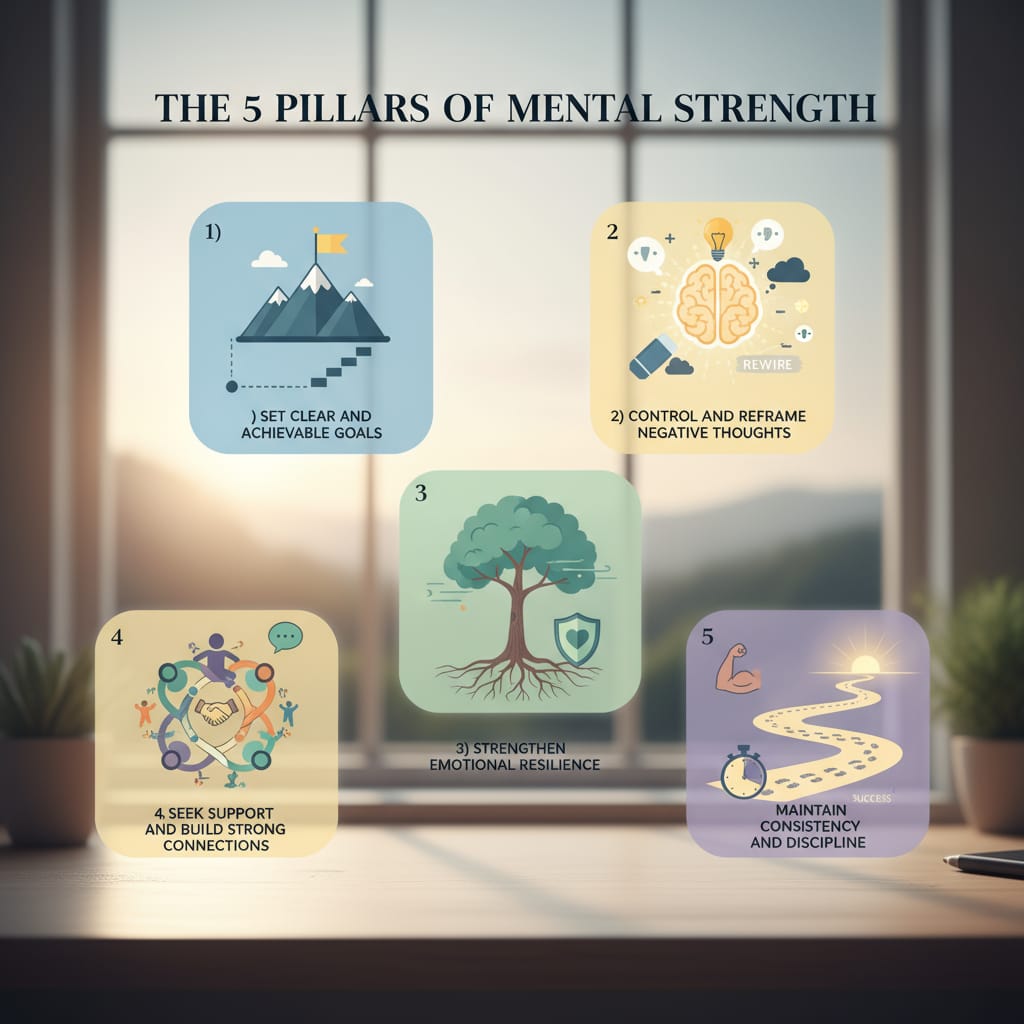
Practice 5: Set Clear and Achievable Goals
How to Build Mental Strength involves setting clear goals. Goals create direction and purpose, preventing stress caused by confusion or lack of focus.
Using the SMART framework (Specific, Measurable, Achievable, Relevant, Time-bound) ensures clarity. For example, instead of saying, “I want to be healthier,” a SMART goal is, “I will jog for 30 minutes, 4 days a week, for the next 2 months.”
Clear goals not only reduce anxiety but also fuel peak performance. Athletes, professionals, and students who set structured goals perform consistently better because they know exactly what they are working toward.
Practice 6: Control and Reframe Negative Thoughts
How to Build Mental Strength requires learning to control negative thinking. Everyone experiences self-doubt, but mentally strong individuals reframe these thoughts into empowering ones.
Techniques like cognitive reframing, positive affirmations, and visualization are powerful tools. Instead of saying, “I can’t handle this,” replace it with, “I will take it one step at a time.”
For example, athletes often visualize winning before competitions, which reduces anxiety and sharpens focus. Similarly, students preparing for exams benefit from affirmations like, “I am prepared, and I can handle challenges calmly.”
Practice 7: Strengthen Emotional Resilience
How to Build Mental Strength also depends on emotional resilience—the ability to bounce back from setbacks. Everyone faces rejection, failure, or unexpected challenges, but resilience decides whether we break down or rise stronger.
Building resilience involves patience, adaptability, and perspective. For example, J.K. Rowling faced multiple rejections before publishing Harry Potter, but her resilience turned setbacks into success.
Practical steps include practicing gratitude, learning problem-solving skills, and reminding yourself that setbacks are temporary. This approach turns obstacles into stepping stones for growth.
Practice 8: Seek Support and Build Strong Connections
How to Build Mental Strength is not a solo journey. Social connections provide emotional support, perspective, and encouragement. Friends, mentors, or therapists act as pillars during stressful times.
Studies show that people with strong social support networks recover from stress faster and live healthier lives. Talking to someone reduces emotional burden and provides new insights.
For example, students discussing exam stress with peers often feel lighter and more motivated. Professionals with mentors make better career decisions under pressure.
Practice 9: Stay Adaptable and Flexible in Uncertainty
How to Build Mental Strength requires adaptability. Life is unpredictable, and rigidity often leads to frustration. Mentally strong people stay flexible, adjusting strategies without losing sight of long-term goals.
For example, businesses that adapted during the COVID-19 pandemic by going digital survived and even thrived, while rigid ones struggled. Adaptability ensures survival and growth even in uncertain times.
Practice 10: Maintain Consistency and Discipline
How to Build Mental Strength is built on consistency. Small daily actions, repeated over time, create massive results. Discipline ensures that you stay committed even when motivation fades.
For example, waking up at the same time daily, maintaining routines, or practicing skills consistently leads to mastery. Athletes who train daily, regardless of mood, achieve peak performance because discipline becomes second nature.
Practice 11: Celebrate Small Wins to Boost Motivation
How to Build Mental Strength also means appreciating progress. Celebrating small wins boosts confidence, fuels motivation, and reduces stress.
For example, acknowledging progress in fitness by tracking milestones keeps motivation high. Similarly, celebrating small academic improvements helps students stay focused on larger goals.
Small wins act as psychological rewards, reminding us that success is a journey, not just a destination.
Daily Practices to Sustain Mental Strength
How to Build Mental Strength isn’t a one-time task but a lifelong journey. Daily practices like gratitude journaling, meditation, and consistent routines sustain progress.
Gratitude journaling shifts focus from stress to appreciation, reducing anxiety. Meditation improves focus and emotional stability. Simple affirmations like, “I am capable and calm,” strengthen resilience when repeated daily.
Consistency is key—just 10–15 minutes of mindful practice daily can transform stress levels and improve long-term performance.
Common Mistakes to Avoid While Building Mental Strength
How to Build Mental Strength also requires awareness of common mistakes. Ignoring stress signals, chasing perfection, or neglecting physical health weakens resilience.
Many people overload responsibilities thinking it shows strength, but it often leads to burnout. Similarly, focusing only on mental practices without sleep, diet, or exercise creates imbalance.
The key is balance: recognize limits, prioritize rest, and focus on progress rather than perfection.
Challenges in Building Mental Strength
How to Build Mental Strength comes with challenges such as lack of awareness, overdependence on external motivation, balancing work-life pressures, and fear of failure.
For example, students may rely only on motivational videos but fail to build discipline. Professionals may struggle to balance personal and professional commitments. Fear of failure often paralyzes people before they even start.
Recognizing these challenges early allows us to create strategies to overcome them.

Solutions and Best Practices for Long-Term Mental Strength
How to Build Mental Strength effectively requires solutions like seeking professional help, making sustainable lifestyle changes, and building positive routines.
Therapists, coaches, and mentors provide guidance. Balanced sleep, diet, and exercise create mind-body harmony. Positive rituals such as morning meditation or evening reflection reinforce consistency. Lifelong learning and adaptability ensure continuous growth.
Real-Life Examples of Mental Strength in Action
How to Build Mental Strength becomes easier when we see real-life role models.
Athletes: Michael Jordan was cut from his high school team but used it as motivation to become one of the greatest basketball players ever.
Entrepreneurs: Steve Jobs faced failure at Apple before returning and building it into a global giant.
Students: Many toppers manage exam stress by creating schedules, practicing mindfulness, and celebrating small wins.
Everyday Heroes: People overcoming illnesses, financial struggles, or personal losses show that resilience is possible for everyone.
FAQs on How to Build Mental Strength
Q1: What is the fastest way to build mental strength?
The fastest way is consistency in small habits like mindfulness, journaling, and stress management techniques.
Q2: Can mental strength reduce anxiety?
Yes, strong mental practices lower stress hormones and build calmness, reducing anxiety symptoms.
Q3: How long does it take to build mental strength?
It depends on consistency, but noticeable changes often appear within 2–3 months of practice.
Q4: Is mental strength the same as emotional intelligence?
Not exactly. Emotional intelligence is about recognizing and managing emotions, while mental strength includes resilience, focus, and discipline.
Q5: Can anyone achieve peak performance with mental strength?
Yes. Mental strength gives clarity, discipline, and resilience, which are foundations of peak performance in any field.
Conclusion
How to Build Mental Strength is not just a question—it’s a lifelong practice and a personal journey that evolves with time, experience, and resilience. The 11 proven practices we have discussed—from cultivating self-awareness to celebrating small wins—are not meant to be mastered overnight. Instead, they serve as a roadmap that helps you navigate stress management effectively while unlocking your highest potential for peak performance.
When we talk about mental strength, it’s important to remember that it does not mean becoming immune to stress, pain, or failure. Life will always bring uncertainty, unexpected challenges, and emotional ups and downs. The true essence of building mental strength lies in learning how to respond, not just react. For example, athletes train their bodies through daily drills, strict diets, and recovery routines. Similarly, the mind needs regular workouts—practices such as mindfulness, journaling, or reframing negative thoughts—to stay resilient.
How to Build Mental Strength also requires balance. If you only focus on discipline and ignore rest, your mind can burn out. If you only focus on positive thinking but avoid addressing real problems, your growth will be limited. True strength lies in balancing emotional awareness with action, self-compassion with accountability, and ambition with acceptance. This balance is what creates a foundation for sustainable stress management and lasting peak performance.
How to Build Mental Strength, Let’s not forget the role of consistency. Small, steady habits practiced daily build greater strength than occasional bursts of effort. For instance, writing down three things you’re grateful for every night may seem simple, but over months, it rewires your brain to notice positivity even during stress. Similarly, celebrating small wins—like finishing a project on time or resisting negative self-talk—gradually builds confidence and mental resilience.
How to Build Mental Strength is also deeply connected to relationships and community. Humans are wired for connection, and leaning on trusted friends, mentors, or therapists does not make you weak. Instead, it reinforces resilience by reminding you that you are not alone in your struggles. In fact, some of the strongest individuals are those who know when to seek help.
Moreover, the journey of mental strength is never a straight line. There will be setbacks, moments of self-doubt, and times when stress feels overwhelming. But each challenge is an opportunity to apply the practices you’ve learned. For example, when you fail at a task, instead of dwelling on disappointment, you can reframe it as feedback to improve. When you feel stressed, you can use breathing exercises or time management strategies to regain focus. Every setback, when approached mindfully, becomes a stepping stone toward greater resilience.
How to Build Mental Strength is, therefore, not about eliminating weaknesses but transforming them into lessons. It’s about turning obstacles into opportunities for growth. When you integrate practices like emotional resilience, adaptability, and discipline into your daily life, you don’t just survive stress—you thrive through it. That is where peak performance naturally emerges, whether in academics, work, relationships, or personal ambitions.
How to Build Mental Strength is not a destination—it is a lifelong journey of becoming the best version of yourself. By applying these practices consistently, you not only enhance your stress management skills and achieve peak performance.
In the end, mental strength empowers you to face life with courage, recover from failures with dignity, and achieve success with humility. It reminds you that while you cannot always control external circumstances, you can always control your inner world. That is where true power lies. And once you master that, no challenge is too great, no stress too overwhelming, and no dream too big.
Great Insight 👍
Thanks