

Table of Contents
1. Introduction
Positive affirmations are more than just motivational words; they are mental tools that can transform the way we think, feel, and act in our everyday lives. In a world where stress, anxiety, and negative thoughts often dominate our inner dialogue, affirmations provide a structured way to replace self-doubt with self-belief. They allow us to consciously reprogram our subconscious mind to focus on growth, resilience, and confidence instead of fear and limitation.
Think about how often you hear your inner critic say things like, “I’m not good enough,” “I always mess up,” or “I’ll never achieve this.” Over time, these repetitive negative thoughts become self-fulfilling prophecies, shaping how you act and respond to challenges. Positive affirmations interrupt this cycle by replacing toxic inner dialogue with constructive, empowering statements like “I am capable,” “I learn and grow every day,” or “I have the power to achieve my goals.”
Unlike short-term motivational quotes, affirmations work because they are deeply personal. They are not just read once and forgotten; they are repeated until they become ingrained in your mindset. By practicing affirmations consistently, you shift your inner dialogue from fear-driven to strength-driven, enabling long-term transformation in both mental wellness and personal develpoment.
Imagine waking up every morning and telling yourself, “I am confident, I am worthy, and I can handle anything that comes my way.” Over time, these words begin to shape your reality. Your thoughts change, your actions align with those thoughts, and your life slowly but surely transforms.
This blog will dive deep into the science, psychology, and practical applications of positive affirmations. We’ll explore why they work, how they boost confidence, and nine powerful techniques that you can apply to overcome negative thoughts and achieve mental clarity.
2. Understanding Positive Affirmations
Positive Affirmations are short, uplifting statements designed to encourage a healthier, more empowering outlook on life. They focus on replacing self-defeating thoughts with constructive ones, creating a mindset that thrives on possibilities rather than limitations.
For example:
Negative affirmation: “I am not smart enough to succeed.”
Positive Affirmation: “I am constantly learning, improving, and growing every day.”
This simple shift in language may seem minor, but it has a profound impact on how you perceive yourself and your abilities. Words carry energy, and when repeated regularly, they train the subconscious mind to accept them as reality, gradually transforming thought patterns and behaviors.
At a psychological level, Positive Affirmations fall under the concept of self-talk. Every person experiences an ongoing internal dialogue, whether positive or negative. This self-talk shapes beliefs, emotions, and actions. Negative self-talk can lower confidence and create barriers, while positive self-talk motivates, strengthens, and nurtures personal growth.
Importantly, Positive Affirmations are not about ignoring problems or pretending everything is perfect. Instead, they redirect focus from what is uncontrollable to what can be influenced. They foster a growth-oriented perspective, helping individuals approach challenges with resilience, optimism, and a proactive mindset.
When practiced consistently, Positive Affirmations help individuals improve emotional well-being, reduce self-doubt, build self-esteem, and develop clarity about personal goals. This is why they are increasingly used in therapy, coaching, education, and workplaces that prioritize mental wellness and personal development.
3. Science Behind Affirmations and the Mind
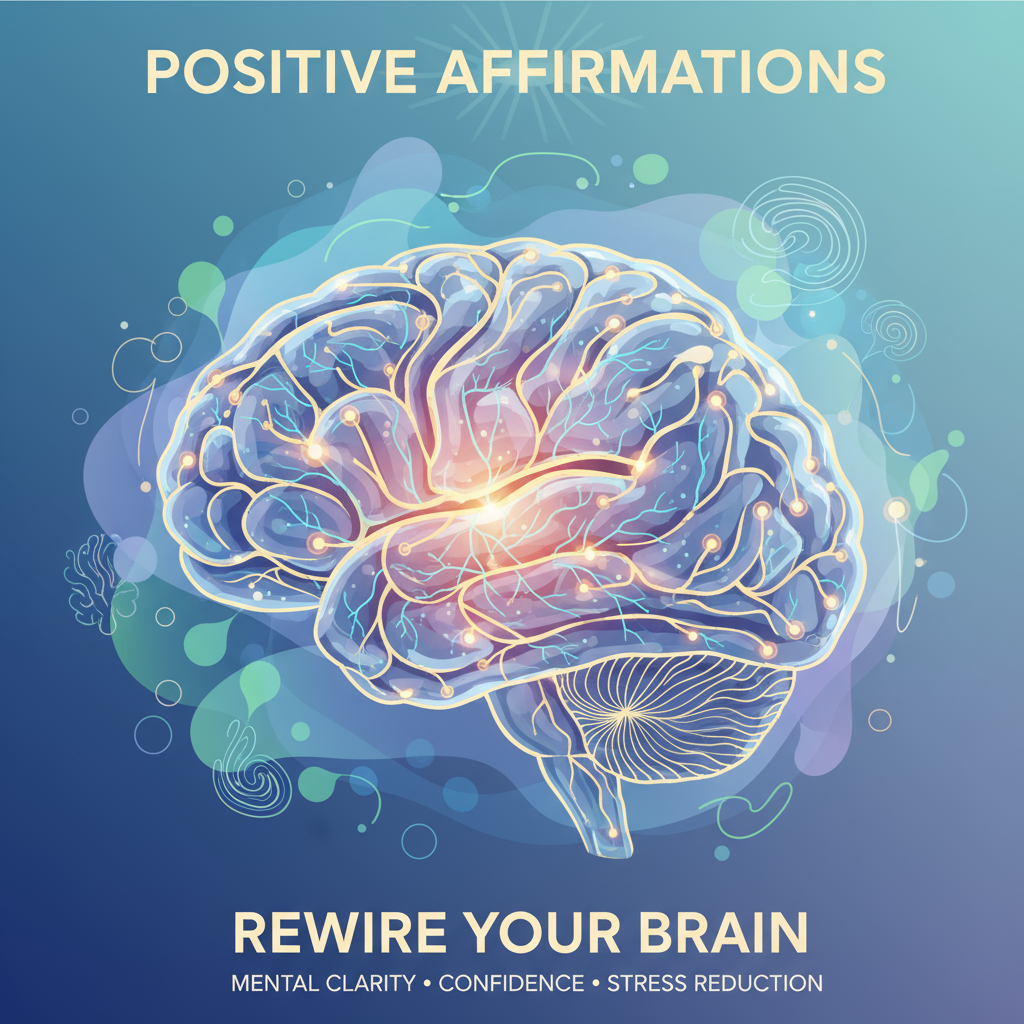
To understand the power of Positive Affirmations, we need to look at how the brain processes thoughts. Neuroscience research shows that our thoughts create neural pathways—connections in the brain that strengthen with repetition. This phenomenon is called neuroplasticity, meaning the brain is flexible and can be rewired based on repeated behaviors or thought patterns.
When you repeatedly tell yourself, “I am confident,” your brain gradually starts to accept this as a belief. Over time, these neural connections strengthen, reducing the influence of negative thoughts while reinforcing positive ones. This is why daily practice of Positive Affirmations can have such a profound impact on mindset and self-perception.
Several studies support this effect. A 2016 study published in Social Cognitive and Affective Neuroscience found that self-affirmation activates the reward centers of the brain—the same areas triggered by pleasurable experiences like listening to music or enjoying a favorite meal. This shows that Positive Affirmations are more than just words; they actively engage the brain’s reward system to create a sense of satisfaction and motivation.
Positive Affirmations also reduce cortisol levels, the stress hormone, helping regulate emotions and promoting calmness. Psychologists have observed that people who practice affirmations perform better under stress because their minds remain focused and clear, allowing them to solve problems more effectively.
In essence, Positive Affirmations are not just motivational slogans—they literally rewire the brain. By creating new, constructive thought patterns, they help individuals break free from cycles of self-doubt and replace them with cycles of self-confidence, resilience, and mental clarity.
4. Why Positive Affirmations Work in Boosting Confidence and Overcoming Negative Thoughts
Negative thoughts are like mental roadblocks. They not only hold you back from achieving goals but also weaken your confidence. Affirmations act as powerful mental tools that dismantle these barriers and replace them with supportive beliefs that fuel growth and positivity.
For instance, someone constantly thinking, “I always fail,” may avoid trying new opportunities altogether. But if that person consistently practices affirmations like, “I learn from every experience and grow stronger each day,” the mindset gradually shifts from fear of failure to acceptance of growth and resilience. This simple change in thought pattern can transform how one approaches challenges.
Affirmations are effective in building confidence for several reasons. First, they silence the inner critic by directly challenging negative self-talk and reducing its influence. Second, they create mental resilience by reinforcing your belief in your ability to overcome obstacles. Lastly, they promote courage, because when you believe in yourself, you are naturally more willing to take risks and step outside of your comfort zone.
Real-life examples highlight this power. Athletes often use affirmations like, “I am strong, focused, and ready to win,” to enhance performance under pressure. Entrepreneurs rely on affirmations such as, “I attract opportunities and success,” to stay motivated during setbacks. Students also benefit by repeating affirmations like, “I am capable of learning and excelling,” before exams to reduce anxiety and perform better.
Affirmations, therefore, act as a bridge between where you are and where you want to be. They don’t just eliminate negative thoughts; they replace them with empowering beliefs that inspire growth, build confidence, and strengthen resilience in every aspect of life.
5. Positive Affirmations: 8 Powerful Techniques
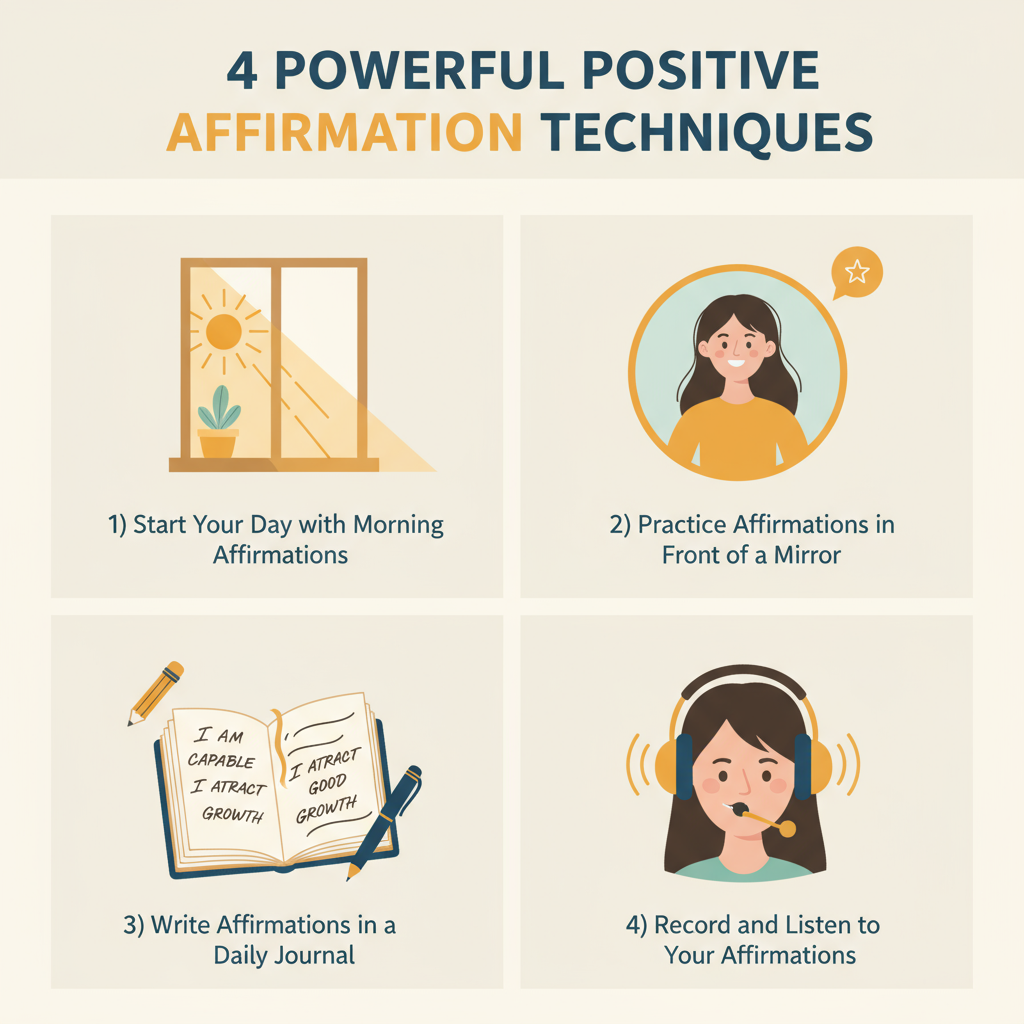
Technique 1: Start Your Day with Morning Affirmations
The first few minutes after waking up are like a blank canvas for your mind. During this time, your subconscious is highly receptive because your brain transitions from the theta state (deep relaxation) to the alpha state (light focus). By beginning your day with affirmations, you set the foundation for how you think, feel, and act throughout the day. Morning affirmations work like mental training—they program your mindset to focus on positivity, self-worth, and productivity instead of stress or self-doubt.
Why it works: According to psychology, morning routines influence your cognitive bias—meaning if you start with positive thoughts, your brain filters daily experiences through a more optimistic lens.
Practical Tip: Create a list of 5–7 morning affirmations such as:
- “Today, I will stay focused and achieve my goals.”
- “I am grateful for new opportunities.”
- “I choose calmness and confidence in every situation.”
Repeat them aloud while standing tall, taking deep breaths, and smiling. Doing this daily helps train your brain to expect good outcomes and stay motivated.
Technique 2: Practice Affirmations in Front of a Mirror
Speaking affirmations into a mirror is more powerful than simply saying them silently because it engages both visual and auditory senses. Looking directly into your own eyes creates a sense of accountability and reinforces belief. This technique is widely used in cognitive-behavioral therapy (CBT) to reframe negative self-talk into constructive dialogue.
Why it works: Studies show that when you speak to yourself in the mirror, your brain interprets it as a conversation with someone else, making it harder to dismiss the words as false. Over time, this strengthens your self-concept and reduces inner criticism.
Practical Tip: Stand in front of the mirror every morning, maintain eye contact, and say affirmations such as:
- “I am worthy of love and success.”
- “I radiate confidence and positivity.”
Do this for 2–3 minutes. The key is consistency and speaking with conviction, even if it feels awkward in the beginning.
Technique 3: Write Affirmations in a Daily Journal
Writing affirmations is a powerful way to engage your brain more deeply than just speaking. When you write something, your reticular activating system (RAS)—the brain’s filter for attention—recognizes it as important, making it more likely to influence your thoughts and actions.
Why it works: Journaling strengthens memory pathways. Psychologists call this the “generation effect”—the act of writing your own words makes the message more memorable than simply reading or listening.
Practical Tip: Dedicate one page of your journal exclusively to affirmations. Write each affirmation 5–10 times to internalize it. For example:
- “I am becoming more confident each day.”
- “I attract opportunities aligned with my goals.”
Pair affirmations with gratitude journaling. For example: write an affirmation followed by something you are grateful for that supports it. This builds both positivity and emotional resilience.
Technique 4: Record and Listen to Your Affirmations
Listening to affirmations in your own voice creates a feedback loop in your subconscious. For auditory learners, this method can be especially impactful because hearing your voice repeatedly builds familiarity and acceptance.
Why it works: Neuroscience explains that repetition combined with auditory reinforcement rewires neural pathways—a process known as neuroplasticity. Over time, the brain starts to replace old limiting beliefs with empowering ones.
Practical Tip: Record affirmations on your phone using calm, clear speech. Play them before bed, during commutes, or while exercising. Example affirmations:
- “I am capable of achieving my dreams.”
- “I handle challenges with strength and wisdom.”
Listening before sleep is especially effective because the subconscious mind is more active during that phase.
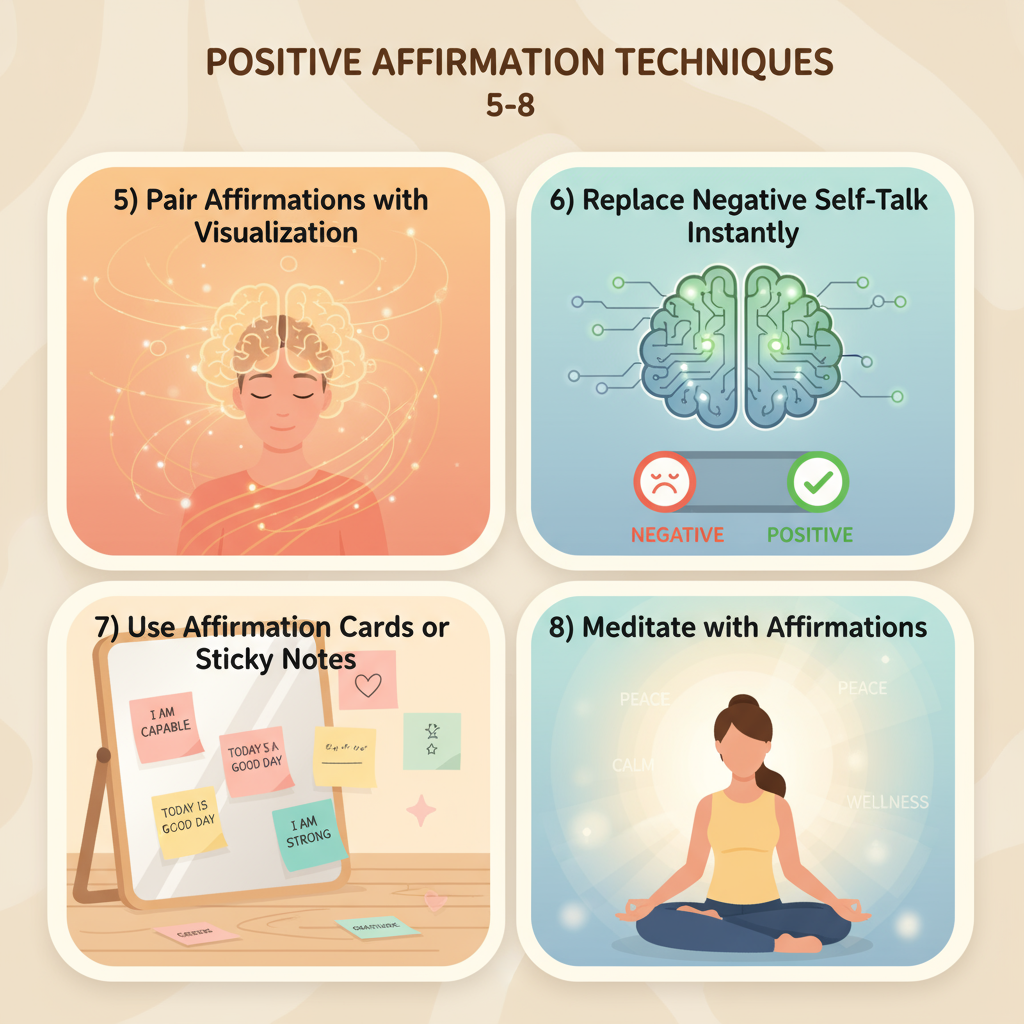
Technique 5: Pair Affirmations with Visualization
Affirmations become even more powerful when combined with visualization, as the brain cannot always distinguish between imagined experiences and real ones. This method activates the same parts of the brain responsible for motivation and action.
Why it works: Athletes and performers often use visualization because it stimulates the prefrontal cortex, strengthening belief in achieving goals. When you visualize yourself succeeding while saying affirmations, you “trick” the brain into believing it has already achieved success.
Practical Tip: Close your eyes while repeating affirmations like “I am confident” and imagine yourself delivering a successful presentation, excelling in an interview, or achieving a personal milestone. The stronger the mental image, the more your brain aligns your actions to make it reality.
Technique 6: Replace Negative Self-Talk Instantly
Negative thoughts are inevitable, but the key is to catch them quickly and replace them with empowering affirmations. This process, called cognitive restructuring, is a cornerstone of psychology for overcoming limiting beliefs.
Why it works: Every thought creates a neural pathway. By immediately replacing “I can’t” with “I can,” you weaken the negative pathway and strengthen the positive one. Over time, the brain defaults to optimism instead of self-doubt.
Practical Tip: Whenever you hear your inner critic say, “I’m not good enough,” instantly counter with:
- “I am capable and prepared to face challenges.”
- “I am learning and growing every day.”
Keep a mental list of 3–4 affirmations ready to use in such moments. This makes it easier to redirect your focus.
Technique 7: Use Affirmation Cards or Sticky Notes
Placing affirmations in visible areas serves as a constant reminder of your goals and values. The more often you see them, the more they become part of your thought process.
Why it works: This works through environmental priming—surrounding yourself with positive messages trains your subconscious to adopt them as truths.
Practical Tip: Write affirmations like “I believe in myself” on sticky notes and place them on your mirror, desk, or laptop. You can also use affirmation cards and carry one in your wallet for quick motivation during stressful moments.
Over time, these small reminders influence decision-making and behavior by keeping positivity at the forefront of your mind.
Technique 8: Meditate with Affirmations
Meditation quiets the mind, making it more receptive to affirmations. When combined, they create a powerful practice for emotional healing and focus. Meditation allows affirmations to bypass mental resistance and reach the subconscious.
Why it works: Research shows that meditation reduces stress and improves neuroplasticity. When affirmations are repeated during meditation, they anchor deeply because the brain is in a relaxed, open state.
Practical Tip: Sit in a quiet space, close your eyes, and focus on your breathing. Once your mind is calm, silently repeat affirmations like:
- “I am at peace with myself and my journey.”
- “I trust the process of life.”
Start with 5 minutes daily and gradually extend the duration. Over time, this practice will cultivate inner calm and lasting self-belief.
6. Benefits of Practicing Positive Affirmations
Positive Affirmations are powerful mental tools that go beyond simple motivational quotes. They have the ability to reprogram your subconscious mind and influence the way you think, feel, and act in daily life. When practiced consistently, Positive Affirmations create both short-term improvements—like reduced stress and better focus—and long-term transformations such as stronger confidence, resilience, and mental well-being.
One of the biggest benefits of Positive Affirmations is a boost in confidence. By repeating affirmations like “I am confident and capable,” you train your brain to replace self-doubt with self-belief. Psychology suggests that the mind interprets affirmations as repeated instructions, and over time, your subconscious accepts them as reality. For example, before interviews or exams, Positive Affirmations can reduce nervousness and enhance performance.
Positive Affirmations also help overcome negative thoughts. Many people fall into patterns of self-criticism or feelings of inadequacy, which hold them back. Affirmations act as an immediate counter-response, helping to challenge and replace these negative beliefs. Saying “I am improving every day” instead of “I’m not good enough” gradually rewires your thinking patterns to be more supportive and growth-oriented.
Another key benefit of Positive Affirmations is stress and anxiety reduction. Neuroscience research shows that affirmations activate the brain’s reward system, releasing dopamine while lowering stress hormones like cortisol. This creates a calming effect, especially in high-pressure moments. Repeating affirmations such as “I am calm and in control” before deadlines or public speaking events can significantly reduce anxiety and improve composure.
Positive Affirmations also sharpen focus on personal and professional goals. When you affirm your intentions, you activate the Reticular Activating System (RAS) in the brain, which filters opportunities and helps you stay aligned with your priorities. For instance, using affirmations like “I am disciplined and committed to my health” reinforces behaviors such as regular exercise and healthy eating.
Lastly, Positive Affirmations contribute to better mental wellness by encouraging optimism, resilience, and a growth mindset. Instead of viewing challenges as barriers, you begin to see them as opportunities for learning and self-improvement. A person dealing with setbacks can use affirmations like “I am healing and growing stronger each day” to nurture hope and emotional balance.
In summary, Positive Affirmations build confidence, replace negative thoughts, reduce stress, improve focus, and promote overall mental health. Whether you are a student, professional, or someone navigating personal struggles, affirmations provide a reliable way to strengthen your mindset and create lasting positive change. With daily practice and consistency, Positive Affirmations become a guiding force for success, resilience, and inner peace.
7. Practical Tips to Stay Consistent with Affirmations
Positive Affirmations are most effective when practiced with consistency. Saying them once or twice won’t bring lasting change—just like exercising a single time won’t make you fit. To truly rewire your subconscious and see transformation, Positive Affirmations must become a regular habit. Consistency is the foundation of success, and here are some powerful tips to help you stay on track.
The first tip is to keep Positive Affirmations short and clear. Simple and precise statements such as “I am confident and capable” or “I am calm and in control” are far more impactful than long, complicated sentences. Short affirmations are easier for the brain to process, repeat, and internalize. For instance, instead of saying, “I will eventually become a confident person in all areas of my life despite challenges,” simply say, “I am confident in every situation.” This makes it easier to repeat daily and recall during stressful moments.
Another strategy is to make Positive Affirmations a natural part of your daily routine. Just as brushing your teeth or having morning tea are non-negotiable habits, affirmations should seamlessly blend into your schedule. Linking Positive Affirmations to existing routines makes them easier to maintain. For example, you can repeat them while brushing your teeth, during your commute, or before going to bed. When affirmations become part of your lifestyle, consistency happens effortlessly.
Equally important is speaking your Positive Affirmations with conviction. Whispering them half-heartedly won’t create a strong impact. Instead, use a confident tone and repeat them with emotion and belief. Stand tall, look into the mirror, and affirm boldly, “I am successful, and I achieve my goals daily.” This practice, supported by embodied cognition, shows how your posture and tone can strengthen the brain’s acceptance of affirmations as truth.

Tracking your progress is another powerful way to stay motivated. Positive Affirmations work gradually, so keeping a journal allows you to notice even small shifts in your mindset. Write down your chosen affirmations daily and reflect weekly: “Did I feel more confident? Did I notice fewer negative thoughts?” This simple habit not only reinforces your practice but also helps you appreciate the progress you are making.
Finally, patience and persistence are crucial. Positive Affirmations reshape neural pathways in the brain, which takes time and repetition. Just like building a new skill or language, consistent practice leads to lasting change. Some people feel results in a few days, while for others it takes weeks or months. The key is to not give up too early. Every repetition strengthens your new mindset, and over time, affirmations will become second nature.
In conclusion, the real power of Positive Affirmations comes from daily consistency. Keep them short, make them part of your routine, speak with conviction, track your journey, and remain patient. With dedication, Positive Affirmations transform from simple words into beliefs that shape your thoughts, actions, and identity—ultimately creating a more confident, focused, and resilient version of yourself.
8. Conclusion
Positive Affirmations are not just words you whisper or write down—they are a powerful tool for transformation. They have the ability to rewire your thoughts, reshape your beliefs, and redirect the course of your life. When used consistently, affirmations serve as mental anchors that keep you grounded during storms of self-doubt and as stepping stones that guide you toward growth, resilience, and fulfillment.
Think of affirmations as the internal software of your mind. Just as a computer functions based on its programming, our actions and decisions are driven by the beliefs we feed our subconscious. If the programming is filled with fear, insecurity, or negativity, it limits our potential. But when we consistently repeat positive affirmations like “I am confident, I am strong, I am capable of achieving my goals,” we install empowering beliefs that fuel success, emotional balance, and personal growth.
The true power of affirmations lies in consistency and belief. You cannot repeat a phrase once and expect your life to transform instantly. Just as physical fitness requires daily exercise, mental fitness requires daily affirmations. Over time, this practice creates new neural pathways in the brain, gradually replacing old patterns of self-doubt with empowering thoughts of strength and possibility.
Imagine the contrast: starting your day with the thought “I always fail” versus starting with “I learn from every experience and grow stronger each day.” One thought drains your energy before you’ve even begun, while the other fuels you with determination and optimism. Over weeks and months, this difference becomes life-changing—it affects the risks you take, the opportunities you attract, and the resilience you show during challenges.
Affirmations also influence not just your inner world but your external reality. A confident mindset changes how you speak, how you present yourself, and how others perceive you. People are naturally drawn to those who radiate positivity and self-assurance, opening doors to stronger relationships, career opportunities, and personal achievements.
But here’s the key truth: affirmations are not about denying reality or ignoring struggles. They are about reframing how you respond to challenges. Life will always bring setbacks, but affirmations equip you with the mental strength to say, “I am capable of handling this. I can find a way through.” This shift in perspective is often the difference between giving up and growing stronger.
If you want Positive Affirmations to truly transform your life, integrate them into your daily routines. Speak them aloud in front of a mirror, write them in a journal, meditate with them, visualize them, or place sticky notes with affirmations around your workspace. The more you interact with them, the more deeply they become part of who you are.
You are stronger than your doubts, braver than your fears, and more capable than you realize. With positive affirmations, you are not just repeating words—you are creating a new reality, one filled with confidence, clarity, and purpose.